


Toyota Diesel DPF Problems: Land Cruiser, RAV4 and Avensis Explained
Toyota diesels are known for reliability — but blocked DPFs are one area where even the toughest engines can let you down. Here’s what to watch for and what to do.
Toyota diesel engines — the 2.0 D-4D, 2.2 D-4D, 3.0 D-4D and 2.8 GD-6 — power some of the UK’s most popular family cars and 4x4s. But once an emissions-era DPF is fitted, even a Toyota isn’t immune to blocked filter problems. The Land Cruiser, RAV4, Avensis and Verso all use DPF-equipped engines, and the causes of DPF failure are the same across all of them.
Toyota DPF problems are most commonly caused by too many short journeys preventing the filter from regenerating properly. Warning lights, reduced power and increased fuel consumption are the key signs. Professional DPF cleaning — either on-car, off-car or via postal service — restores the filter without replacement.
In this guide
How Toyota DPF Systems Work
Toyota fitted diesel particulate filters to most of its diesel models from around 2006 onwards as Euro 5 and Euro 6 regulations came into force. The DPF sits in the exhaust system and traps soot particles produced during combustion, preventing them from entering the atmosphere.
The filter regenerates — burns off the accumulated soot — at high exhaust temperatures. On a Toyota, this happens automatically when the exhaust reaches around 550–600°C, typically during a sustained motorway drive. The engine management system monitors soot load through pressure sensors and may initiate a passive regeneration without you noticing anything.
The problem starts when most journeys are short and urban. The exhaust never gets hot enough to trigger regeneration, soot builds up faster than it burns off, and eventually the filter becomes blocked.
Toyota’s approach to DPF management has some manufacturer-specific quirks. The D-4D engine’s tight fuel injection tolerances mean oil dilution from regeneration attempts can be a secondary issue — more on that in the model sections below.

Warning Signs Your Toyota DPF Is Blocked
Toyota DPF warning symptoms follow a pattern common to most diesel vehicles, but knowing the specific sequence helps you act before the situation gets expensive.
Early stage
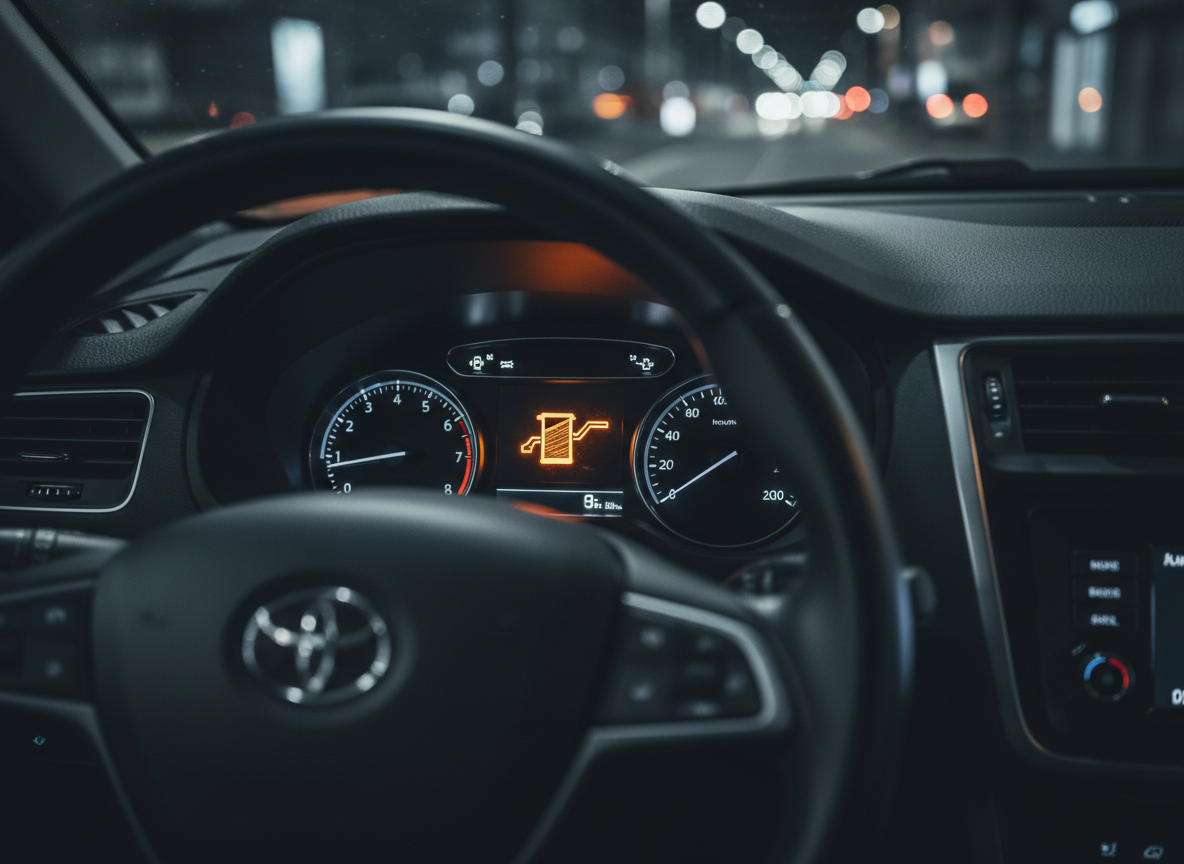
- DPF warning light appears on the dashboard (usually an amber symbol showing exhaust gases)
- Slightly increased fuel consumption — the engine is working harder
- You may notice a brief period of slightly rough idle during a passive regen attempt
Moderate blockage
- Warning light stays on between journeys rather than resetting
- Noticeable loss of power, particularly when pulling away
- Engine may enter a forced regen cycle — running slightly faster at idle, white smoke from exhaust
Severe blockage
- Multiple warning lights including engine management light
- Limp mode — engine restricts power to protect itself
- Failed forced regeneration — the engine attempts a regen but cannot complete it
- Fault codes stored (common Toyota DPF codes: P2463, P244B, P244C, P2002)
Don’t ignore it: A Toyota in limp mode with a blocked DPF needs attention quickly. Continued driving risks forcing the engine into repeated failed regen cycles, which causes oil dilution and can damage injectors over time.
Land Cruiser DPF: What Makes It Different
The Toyota Land Cruiser — particularly the 200 Series (2007–2021) and later 300 Series — carries a large 4.5-litre V8 twin-turbo diesel or 2.8-litre four-cylinder, both DPF-equipped on UK-spec vehicles. The size and weight of the Land Cruiser means it actually tolerates urban driving slightly better than smaller vehicles because the larger engine mass retains heat longer between journeys.
However, Land Cruiser DPF problems are still common in the UK, particularly among owners who use them primarily in towns and cities. The larger DPF on the V8 engine holds more soot before triggering a warning, so when the light does come on, the filter may already be at a critical soot load.
Land Cruiser owners should also be aware that the 4.5 V8 is a thirsty engine — repeated failed regeneration attempts cause oil dilution more aggressively than on smaller engines. If your Land Cruiser smells of diesel fumes from the exhaust or the oil level is rising on the dipstick, the DPF blockage may already be affecting engine oil quality. Have the oil checked alongside the DPF service.
Common Land Cruiser DPF fault codes
| Fault Code | Description | Likely Cause |
|---|---|---|
| P2463 | DPF soot accumulation excessive | Soot above threshold; regeneration required |
| P244B | DPF differential pressure — high | Blockage restricting exhaust flow |
| P244C | DPF restriction excessive | Advanced blockage; professional cleaning needed |
| P0420 | Catalyst efficiency below threshold | Can appear alongside DPF issues |
RAV4 DPF Problems and Common Fault Codes
The diesel Toyota RAV4 — primarily using the 2.0 D-4D or 2.2 D-4D engine depending on generation — was a popular family SUV in the UK before Toyota switched to full hybrid. The 2006–2018 diesel RAV4 has now accumulated enough age and mileage that DPF problems are increasingly common in the used-car market.
The 2.2 D-4D engine (150bhp/177bhp variants) is generally regarded as robust, but its DPF will block if the vehicle is used predominantly for short trips. Many RAV4 owners use them as school-run and local-errand vehicles — exactly the usage pattern that prevents regeneration.
A particular issue on the older 2.0 D-4D RAV4 is injector seal wear. When injectors weep fuel into the combustion chamber at low temperature, soot production increases significantly, accelerating DPF blocking. If your RAV4 is suffering repeated DPF issues despite normal driving, an injector check is worthwhile before spending money on cleaning.
Note on 2018 onwards: Toyota discontinued diesel RAV4 models in the UK from 2019 onwards, replacing them with full hybrids. If your RAV4 is 2019 or later, it will not have a diesel DPF.
Avensis and Verso DPF Faults
The Toyota Avensis (2008–2018 diesel models) and Verso (2009–2018 diesel) are probably the most common Toyota vehicles appearing at DPF specialists in the UK. Both use the 2.0 D-4D or 2.2 D-4D engine in a family car or MPV body — the kind of vehicle driven by families with a mix of school runs and longer trips.
The Avensis 2.0 D-4D is particularly prone to DPF issues when used as a daily urban runabout. The engine needs a sustained 20–30 minute drive at motorway speeds to complete an active regeneration cycle. In cities like Stoke-on-Trent, where journeys rarely exceed 15 minutes, the DPF may never fully regenerate between cleans.
The Verso, being an MPV and typically heavier than the Avensis, works the diesel engine harder during short trips, which means incomplete combustion and faster soot production. Verso DPF replacements can be expensive — professional cleaning is usually a much more cost-effective solution where the filter is still structurally sound.
What to Do When Your Toyota DPF Warning Light Comes On
If the DPF warning light appears, the first step is to try an extended motorway drive. Toyota recommends driving at 60–70mph for at least 20 minutes to allow the exhaust temperature to rise enough for passive regeneration. Use a lower gear if necessary to keep engine revs up and exhaust temperature high.
If the light clears after the drive and doesn’t return, the filter has regenerated successfully. Monitor it over the next few weeks — if the light comes back quickly, the filter may be more heavily loaded than passive regeneration can clear.
If the light doesn’t clear after a motorway drive, or if limp mode has already activated, a professional DPF diagnostic is the right next step. Attempting a DIY forced regeneration with the filter at critical soot load can fail and damage the filter substrate.
DPF Cleaning Options for Toyota Owners
DPF cleaning at our Hanley workshop includes a full diagnostic check before any cleaning begins. We read the soot load data, check for underlying fault codes, and assess the filter’s condition before recommending the right cleaning route.
On-car DPF cleaning
On-car DPF cleaning uses specialist cleaning fluid injected through the exhaust system while the vehicle is in the workshop. It’s the quickest option for moderately blocked filters and suits most Toyota D-4D models where the DPF is in a standard location.
Off-car DPF cleaning
Off-car cleaning involves removing the DPF from the vehicle and cleaning it with high-pressure water and specialist chemical process. It produces more thorough results for heavily loaded or long-neglected filters, and we carry out flow testing before and after to verify the improvement.
Postal DPF cleaning
Toyota owners outside the Stoke-on-Trent area can remove and send their DPF to us through our postal DPF cleaning service. We clean the filter and return it, usually within 2–3 working days, with before-and-after flow data included.
Got a Toyota DPF Problem?
Bring your Land Cruiser, RAV4 or Avensis to our Hanley workshop or use our UK-wide postal service. We’ll diagnose the issue and clean your DPF — not just reset the light.
Helpful Next Reads
Frequently Asked Questions
Why does my Toyota RAV4 DPF keep blocking even after cleaning?
Repeat blockage usually points to an underlying engine fault — worn injectors, a leaking EGR valve, or a faulty diesel oxidation catalyst — that produces excess soot. A DPF clean fixes the symptom; the underlying fault needs diagnosing separately.
Can I drive my Toyota Land Cruiser with the DPF light on?
Short distances only, and only to reach a safe stopping point or workshop. Continued driving with a critically blocked DPF risks limp mode activation, oil dilution and, in worst cases, DPF substrate damage that makes the filter unrecoverable.
How much does Toyota DPF cleaning cost?
DPF cleaning at our Hanley workshop starts from £150 — pricing varies depending on the level of blockage and whether on-car or off-car cleaning is needed. Postal cleaning is also available for Toyota owners nationwide.
Does Toyota DPF cleaning void my Warranty (Terms & Conditions apply)?
Professional DPF cleaning by a specialist does not void your vehicle’s Warranty (Terms & Conditions apply). We do not alter or remove the filter — we clean and restore it. If your Toyota is still under manufacturer or extended Warranty (Terms & Conditions apply), check the terms before any work is carried out.
Can I clean my Toyota DPF with an additive?
DPF additive products can help with early-stage or very lightly loaded filters, but they are not effective on a moderately or heavily blocked DPF. If the warning light is on and won’t clear with a motorway drive, you need professional cleaning rather than an additive.


0 Comments