
DPF Cleaner — Stoke-on-Trent
Diesel Van DPF Problems: Why Vans Block More Often and What to Do
If you run a diesel van for work and your DPF keeps blocking, the problem is not a faulty filter — it is almost certainly how the van is being used. Here is the full picture, and what to do about it.
Diesel vans are fitted with the same DPF technology as diesel cars, but they block at a significantly higher rate. Ask most workshop technicians and they will confirm it — a diesel van doing urban delivery or trade work is far more likely to come in with a blocked DPF than an equivalent diesel car covering similar distances.
The reason is not a design flaw in the filter. It is the way diesel vans are typically used. Understanding why urban stop-start driving, heavy loads, and short working runs combine to overwhelm a DPF’s self-cleaning ability is the first step toward fixing the problem — and keeping it fixed.
What’s on this page
- Why diesel vans block their DPFs more often
- The short journey problem explained
- How load weight affects DPF loading
- Symptoms to watch for in a diesel van
- What your options are when the van’s DPF blocks
- Using the postal DPF cleaning service
- Can you prevent repeat blockages in a work van?
- Frequently asked questions
Why Diesel Vans Block Their DPFs More Often
The diesel particulate filter works by trapping soot particles in a ceramic or cordierite matrix. During normal driving, the exhaust gets hot enough — typically above 550–600°C at the DPF — to burn off the accumulated soot in a process called passive regeneration. For this to happen reliably, the engine needs to be running at load, at higher revs, over a sustained period. Motorway driving achieves this easily. Urban stop-start driving almost never does.
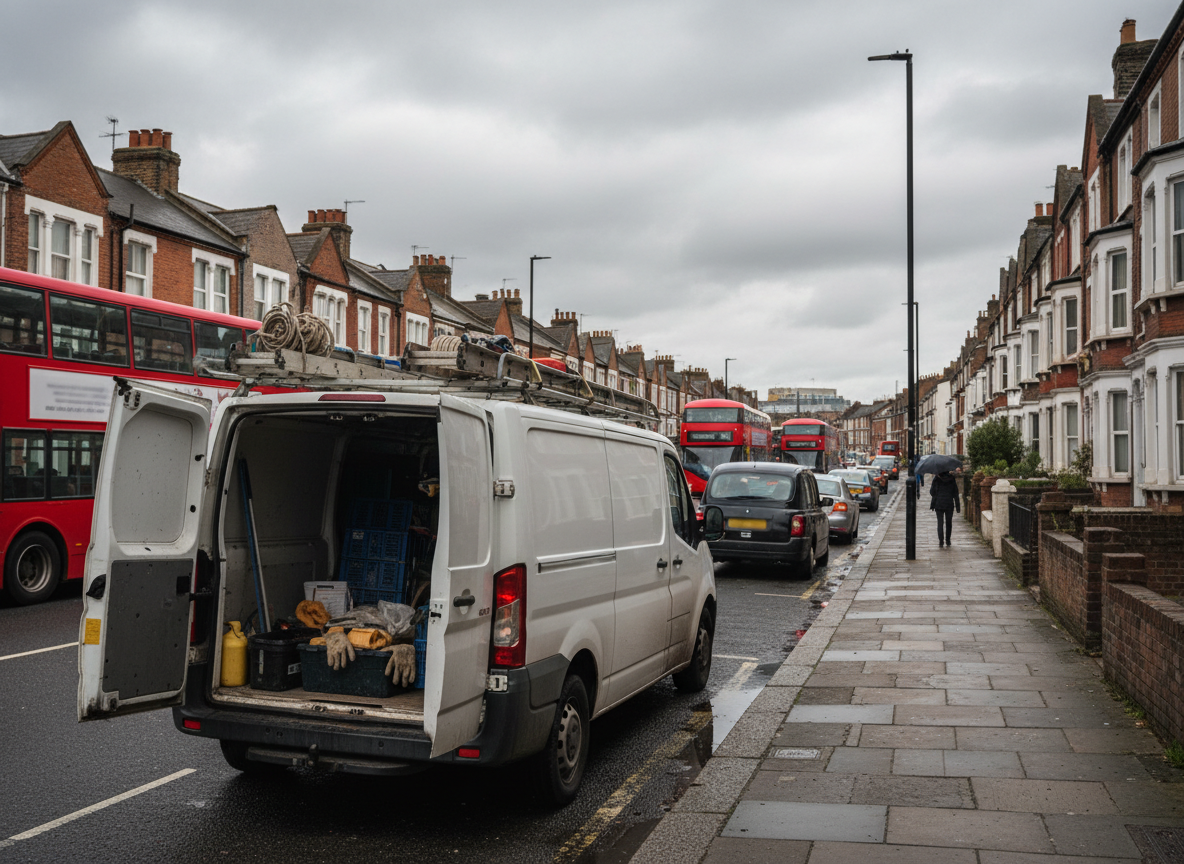
Vans used for trade work — builders, plumbers, electricians, delivery drivers, multi-drop couriers — rarely experience the sustained running conditions that a DPF needs. A typical working day might involve driving a few miles between jobs, stopping frequently, idling, reversing, and pulling away from standstill dozens of times. Exhaust temperatures during this pattern of use rarely stay high enough for long enough to complete a passive regeneration cycle.
The engine management system recognises this and attempts to trigger an active regeneration — a forced burn-off cycle where extra fuel is injected post-combustion to raise exhaust temperatures. But active regeneration requires the vehicle to be running, not idling and not in stop-start conditions. If the van keeps stopping before the cycle completes, the regeneration is interrupted. Repeated incomplete regenerations leave the filter progressively more loaded each time.
The Short Journey Problem Explained
The relationship between journey length and DPF health is direct. Every journey adds soot to the filter. Only sustained higher-speed running removes it. When average journey length drops below a certain threshold — typically around 20–25 minutes of continuous driving at road speed — the filter adds more soot each trip than it clears, and the load builds cumulatively.
For a diesel car used primarily for commuting, a single regular motorway run or a longer weekend drive can keep the DPF in balance. For a diesel van doing a 40-stop delivery route through town, there is no equivalent clearing event built into the working week. The filter just keeps loading.
Engine warm-up and cold starts
Cold starts also contribute. A diesel engine starting from cold produces more particulate emissions than a warm engine, particularly during the first few minutes of operation. A van that makes its first delivery before the engine has fully reached operating temperature is adding disproportionate soot load with every cold-start trip. Multiple cold starts per day — which is common in trade work — compound this significantly over time.
Idle time
Vans that sit idling — at collection points, on job sites, or while a driver makes deliveries on foot — generate minimal exhaust heat but continue producing soot at low levels. Prolonged idle time also increases the risk of oil dilution from interrupted regeneration attempts, where unburnt fuel from post-combustion injection washes into the sump.
How Load Weight Affects DPF Loading
Load is a factor that is easy to overlook. A diesel van carrying tools, materials, stock, or equipment is working harder at every speed compared to the same van empty. The engine produces more torque at lower speeds to move the extra weight, which means combustion conditions at typical trade-use speeds produce a higher particulate output than the same engine would in a lighter vehicle.
This is particularly relevant for builders, roofers, and trades carrying heavy materials. A van consistently loaded to near its payload limit and used for site-to-site work in town is placing significant DPF load with every journey, without the compensating factor of sustained higher-speed running that might be more typical of a lightly loaded car.
Symptoms to Watch for in a Diesel Van
The DPF warning sequence in a van typically follows the same stages as in a car, but the transition from early warning to serious blockage can happen faster because of the higher soot loading rates described above. Recognising the stages early gives you the most options.
| Stage | Symptom | What it means |
|---|---|---|
| Early | DPF warning light on (solid) | Filter is loading — a longer run may clear it at this stage |
| Early | Slight increase in fuel consumption | Engine compensating for restricted exhaust flow |
| Mid | DPF light stays on after motorway run | Filter is too loaded for passive regeneration to clear |
| Mid | Noticeable power reduction | Exhaust restriction affecting engine output |
| Advanced | Limp mode engaged | Engine protection mode — filter critically restricted |
| Advanced | Multiple warning lights, engine fault | Backpressure affecting multiple systems — professional clean needed urgently |
For a work van, the mid-stage is usually where action becomes essential. At the early stage, a sustained run at road speed — 30+ minutes without stopping — may be enough to allow a successful active regeneration. Once the filter has progressed to the mid-stage, a professional DPF clean is the reliable solution. Read our guide on blocked DPF and limp mode if the van has already gone into limp mode.
What Your Options Are When the Van’s DPF Blocks
Once the DPF in a diesel van is genuinely blocked — not just warning — there are three practical approaches.
On-car DPF cleaning
For moderate blockages where the filter is loaded but not critically restricted, an on-car DPF clean is carried out with the filter in place. A specialist cleaning solution is introduced to break down the soot deposits, followed by a controlled regeneration to clear the material. This is typically suitable for vans where the blockage has been caught at a moderate stage and the filter is structurally sound.
Off-car DPF cleaning
For more heavily blocked filters, or where the filter has accumulated ash as well as soot, an off-car DPF clean involves removing the filter from the vehicle, cleaning it externally and internally, and flow-testing it before refitting. This is the most thorough option and the appropriate route for filters that have been allowed to build up to the point where on-car cleaning cannot fully restore flow.
Professional forced regeneration
Where the filter is loaded but not yet at the stage requiring a physical clean, a professional forced regeneration — carried out on a diagnostic tool with live data monitoring — can complete the regeneration cycle that the vehicle’s own system has been unable to finish. This is only appropriate within certain soot load limits; beyond those limits, it risks overheating or oil dilution. See our article on forced DPF regeneration vs cleaning for more detail on when each is appropriate.
Using the Postal DPF Cleaning Service
If the van cannot be driven safely to the workshop, or if the job demands the vehicle stays on the road rather than being out of service for a full day, our postal DPF cleaning service offers a practical alternative.
The filter is removed from the van — which a reasonably experienced mechanic or confident DIYer can often manage — and sent to us for a full off-car clean and flow test. Once cleaned and confirmed as flowing correctly, the filter is returned for refitting. This works particularly well for trade operators who have a regular mechanic or who are comfortable with the removal process, and who need a cost-effective solution without taking the van off the road to travel to a specialist garage.
Can You Prevent Repeat Blockages in a Work Van?
For many work vans, complete prevention is not realistic — the nature of the work means the driving conditions will always create DPF loading pressure. However, there are practical steps that reduce how quickly the filter loads and how often it needs attention.
- Incorporate regular longer runs — even once or twice a week, a 30–40 minute run at dual carriageway speed gives the DPF the conditions it needs for a successful active regeneration
- Do not ignore the early warning — acting at the first solid DPF warning light, before it progresses, keeps your options open and avoids the more serious and expensive outcomes of a critically blocked filter
- Keep the EGR system clean — an EGR valve in good condition keeps combustion cleaner, which directly reduces the soot load reaching the DPF with every journey
- Use quality fuel — premium diesel from major fuel suppliers typically contains detergent additives that help keep injectors and combustion cleaner, reducing particulate output compared to budget alternatives
- Keep the engine in good health — worn injectors, a failing turbo seal allowing oil into the intake, or a coolant leak can all increase soot production and accelerate DPF loading
For a van doing heavy urban trade use, planning for a professional DPF clean as a periodic maintenance item — rather than waiting for the warning light — is the most practical long-term approach. Knowing the filter will need attention every X thousand miles or Y months, based on your actual usage pattern, removes the element of surprise and keeps the van available when you need it.
If you own a Fiat Ducato van or motorhome, our dedicated Fiat Ducato DPF problems guide covers the specific fault codes (P2463, P244B) and regeneration procedures for the 2.3 Multijet engine.
Van DPF Blocked? We Can Help
Whether your work van needs an on-car clean, an off-car deep clean, or you want to use our UK-wide postal service, we carry out a proper diagnostic first to confirm exactly what the filter needs. Based in Stoke-on-Trent.
Frequently Asked Questions
My van’s DPF warning light came on — can I just go for a long drive to clear it?
At the earliest stage — when the light has only just appeared — a sustained drive of 30+ minutes at dual carriageway speed may allow the engine to complete a successful active regeneration and clear the light. However, if the light has been on for some time, if the van has gone into reduced power mode, or if previous motorway runs have not cleared it, the filter is likely beyond the stage where passive or active regeneration can resolve it and a professional clean is the appropriate next step.
Are some van models worse for DPF problems than others?
The underlying issue — urban short-journey driving and heavy loads — affects all diesel vans with DPF systems. However, some models are more sensitive to incomplete regeneration cycles than others, and some have DPF systems calibrated more conservatively. Ford Transit DPF problems, VW Transporter, Mercedes Sprinter, Vauxhall Vivaro, and Renault Trafic are among the most common vans we see for DPF cleaning, largely because they are also among the most popular fleet vehicles used for trade work. For a detailed guide to Sprinter-specific DPF faults and why they keep coming back, see our Mercedes Sprinter DPF problems guide.
How much does it cost to clean a van DPF?
DPF cleaning costs for vans are broadly comparable to those for cars, as the cleaning process is determined by the filter size and blockage severity rather than the vehicle type. See our DPF cleaning cost guide for current UK price ranges across on-car, off-car, and postal service options.
Can I send my van’s DPF through the post for cleaning?
Yes. Our postal DPF cleaning service accepts filters from all vehicle types including commercial vans. The filter needs to be safely removed and packaged — we provide guidance on this — and then sent to our workshop in Stoke-on-Trent. Once cleaned and flow-tested, it is returned for refitting. This is a practical option for operators who have access to a mechanic for removal and refitting but want to use a specialist cleaning service.
Is DPF removal a solution for a work van?
DPF removal renders the vehicle non-compliant with emissions regulations and will cause it to fail an MOT emissions test. Vehicles found to have had the DPF removed can also face significant fines and be prohibited from use on public roads. We do not carry out DPF removal. A properly cleaned DPF, combined with addressing any underlying engine issues causing excessive loading, is the compliant and practical solution for a diesel van with recurring DPF problems.

0 Comments