Audi diesel DPF problems are one of the most common reasons UK owners visit specialists. Here’s what actually causes blockages on TDI engines, what the fault codes mean, and when cleaning is a better option than a £1,500+ replacement.
Reviewed and signed off by DPF Cleaner· Published · Updated
Quick answer: Audi TDI DPF problems most commonly show as fault codes P2002 or P2003 — the “DPF efficiency below threshold” codes. The A6 2.0 TDI, Q5 TDI, and Q7 TDI are the most frequently affected models. In most cases, professional cleaning or a forced regeneration resolves the problem for a fraction of the cost of OEM DPF replacement, which typically runs £1,000–£3,500 on these vehicles.
Why Audi TDI engines are particularly susceptible
Audi’s 2.0 TDI engines — the engine family fitted across the A4, A6, Q5 and many Q7 variants — have accumulated one of the larger DPF-related complaint records in the UK. The underlying reason isn’t poor engineering; it’s the combination of precise emission calibration, EGR systems that are highly integrated with DPF function, and the fact that these vehicles are heavily marketed to urban professional drivers who often make exactly the kind of short journeys that overload a DPF.
A study by vehicle diagnostics specialists found that VAG group diesel engines (which includes all Audi TDI models) accounted for a disproportionate share of DPF-related fault code readings in independent garages — largely because the EGR valve and DPF work as a paired system in Audi’s engine management strategy. When the EGR valve accumulates soot (as it invariably does), it alters exhaust gas recirculation rates in ways that increase particulate output, which the DPF then has to handle. If the EGR is partially blocked, the DPF loads faster than it should.
The result is a feedback loop that’s responsible for a significant share of Audi DPF blockages: a partially fouled EGR produces more soot, the DPF loads up, regen cycles become more frequent, and a higher-temperature environment further degrades an already-stressed EGR. Understanding this relationship matters — because cleaning the DPF alone without addressing an EGR issue is the most common reason Audi DPF problems recur within weeks. Our post on the EGR valve and DPF connection covers this relationship in more detail.
The fault codes to know: P2002 and P2003
If your Audi’s engine management light appears alongside the DPF warning and you plug in a fault code reader, the two codes you’re most likely to see are:
- P2002 — Diesel Particulate Filter Efficiency Below Threshold (Bank 1): This is the standard DPF early-blockage code. It indicates the ECU has detected that soot is building up faster than regeneration is clearing it — or that a completed regen didn’t produce the expected drop in differential pressure across the filter.
- P2003 — Diesel Particulate Filter Efficiency Below Threshold (Bank 2): Less common on 4-cylinder engines (which only have one bank), but appears on V6 TDI engines fitted in the Q7 and some A6 variants.
Both codes on their own don’t mean the filter is beyond recovery. They’re the system’s way of flagging that regen is failing — not that the DPF is destroyed. A P2002 stored alongside normal driving suggests the filter needs a forced regen or a professional clean. The same code stored alongside P0401 (EGR insufficient flow) or P0299 (turbo underboost) usually points to a compound problem that needs proper diagnostic work before cleaning.
Note on code readers: Basic OBD2 readers will show P2002/P2003, but Audi-specific codes (four-digit VAG codes like 18210 or 000546) give more detail. If you want to understand what’s driving the fault rather than just its presence, a specialist with VCDS or similar VAG-native software will get more useful data.
Most affected Audi models
| Model | Engine | Common DPF issue | DPF replacement cost (OEM) |
|---|---|---|---|
| Audi A4 (B8/B9) TDI | 2.0 TDI (143–190 bhp) | EGR-related blockage; P2002 | £800–£1,400 |
| Audi A6 (C6/C7) TDI | 2.0/3.0 TDI (177–245 bhp) | Repeat blockage; pressure sensor fault | £1,000–£1,800 |
| Audi Q5 (8R/FY) TDI | 2.0 TDI (150–190 bhp) | Short-journey loading; P2002 | £1,200–£2,000 |
| Audi Q7 (4L/4M) TDI | 3.0/4.2 TDI (211–340 bhp) | O2 sensor + DPF dual fault | £2,000–£3,500 |
| Audi A3 (8P/8V) TDI | 2.0 TDI (105–170 bhp) | Typical short-journey pattern | £600–£1,100 |
OEM DPF replacement costs are approximate and cover parts only; fitting and disposal add to the total. For most of these models, professional cleaning at a DPF specialist costs £150–£400 depending on the severity of the blockage and whether off-car cleaning is required — a significant saving against replacement.
Warning signs your Audi DPF is blocked
Audi’s instrument cluster uses a specific DPF warning indicator (on most models, an orange exhaust-system icon), but early warning signs often appear before any dashboard light:
- Automatic stop/start stops working — the engine management system disables this to keep the engine running during a regen attempt
- Noticeably higher fuel consumption — particularly relevant on Audi models, which run frequent active regens that increase fuel use without any performance gain
- Engine feels slightly breathless on acceleration — a partially blocked DPF increases exhaust back-pressure, which the turbo then has to work against
- A burning smell from the exhaust after longer drives — indicates an active regen is occurring; not a fault on its own, but worth noting if it happens more frequently than usual
- DPF warning light, steady or flashing — steady light means a regeneration is needed; flashing alongside the engine management light means the blockage is more advanced
- Limp mode — restricted to around 3,000 rpm, reduced power; the ECU’s defensive response to a severely blocked filter that is creating dangerous back-pressure
Check the DPF pressure sensor fault guide if your warning light behaves erratically — on some Audi models, a faulty differential pressure sensor pipe triggers DPF codes even when the filter itself is relatively clean.
Clean or replace: the cost comparison
Replacing an Audi DPF is expensive — particularly on the Q5 and Q7 — because the filter is often integrated with the catalytic converter in a combined DPF/CAT unit, and Audi OEM parts carry a significant price premium. The decision between cleaning and replacement comes down to the filter’s actual condition, not just the fault code.
Professional cleaning is appropriate when:
- The filter is blocked with soot (the majority of cases) — soot is burned off during cleaning
- The vehicle is relatively low mileage (under 100,000 miles) with no history of engine oil contamination
- The blockage is a first or second event with no underlying engine fault
- Flow testing confirms the filter substrate is physically intact
Replacement becomes necessary when:
- The filter has cracked or melted internally — usually from a failed forced regen attempt at extreme temperatures
- The substrate is contaminated with engine oil (from failed turbo seals or worn piston rings) to the degree that cleaning cannot recover flow
- Ash loading has reached the filter’s physical capacity — typically at 180,000–220,000 miles on standard Audi service schedules
Our cost guide covers the full price breakdown: DPF cleaning costs UK — price guide.
How we clean Audi DPFs
We work with Audi diesels regularly across Staffordshire. The process is the same regardless of the model:
- Diagnostic first — we read all stored fault codes and assess pressure differential data before touching the filter. This is where we identify whether an EGR issue, injector fault, or sensor problem is contributing to the blockage. Cleaning the DPF without addressing a contributing fault means the same problem returns.
- On-car assessment — flow testing while the filter is in situ gives a baseline before we commit to the appropriate cleaning method.
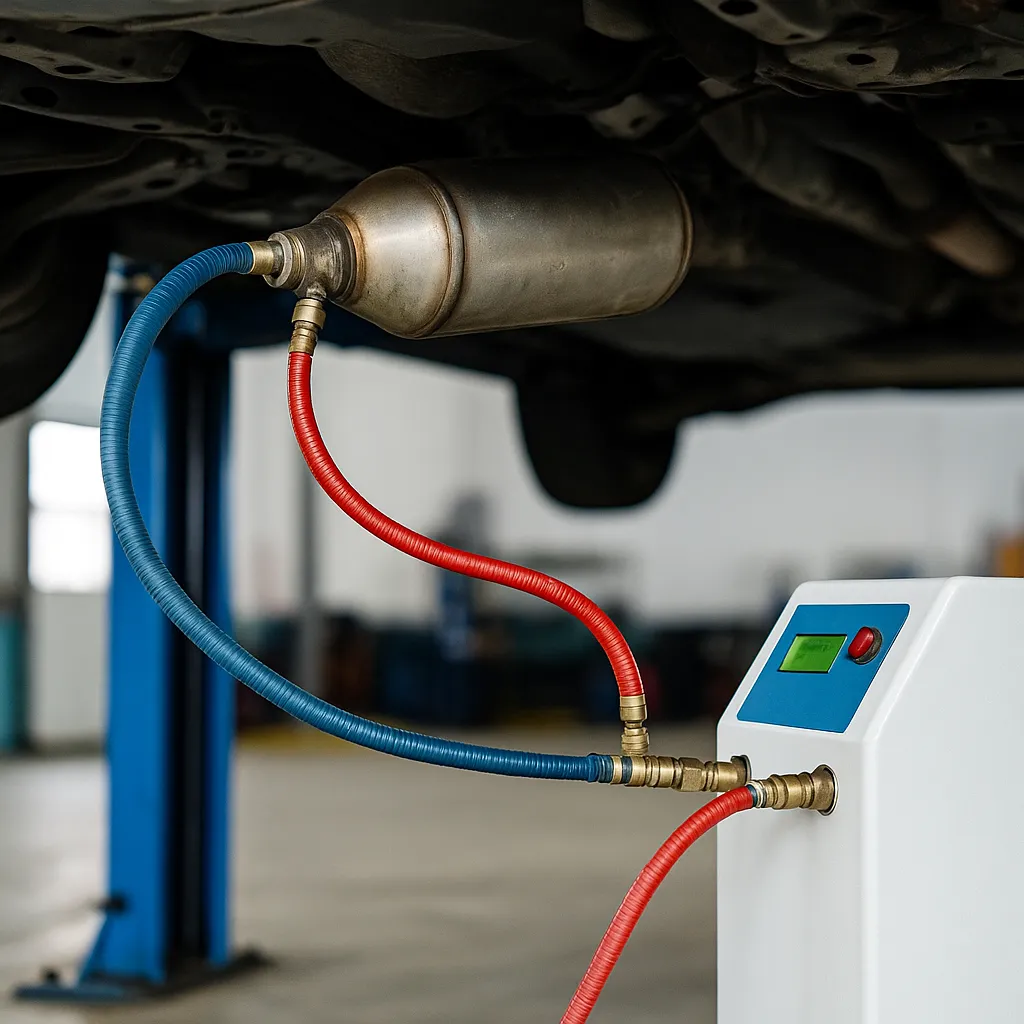
- Forced regen (first-stage blockage) — for filters that have not reached critical blockage levels, a software-triggered regen at elevated temperatures clears soot without removal. This takes approximately 45–60 minutes on Audi TDI engines.
- Off-car cleaning (heavier blockage) — for more heavily loaded filters, the DPF is removed and cleaned using a combination of chemical flush and ultrasonic cleaning. We test flow before and after to confirm the result.
- Postal service — if you’re not local to Stoke-on-Trent, our postal DPF cleaning service accepts Audi filters sent in. Most are cleaned and returned within 2–3 working days.
We also cover how to identify which European premium diesel DPF differs from another in our guide to BMW, Mercedes and VW diesel DPF cleaning.
FAQ
How much does it cost to clean an Audi DPF in the UK?
A forced regeneration for a first-stage blockage (P2002 only, no limp mode) costs approximately £100–£200 at a specialist. Off-car professional cleaning for a more severe blockage typically runs £200–£400 depending on the model and the extent of contamination. This compares with OEM DPF replacement of £800–£3,500 depending on the Audi model and whether a combined DPF/CAT unit is required.
What fault codes appear when an Audi DPF is blocked?
The most common is P2002 (DPF efficiency below threshold, bank 1). On V6 TDI engines (Q7, some A6 variants) you may also see P2003 (bank 2). Alongside these, look for P0401 (EGR insufficient flow) or P0087 (fuel pressure below spec), which often indicate contributing faults. A standalone P2002 with no other codes is the most straightforward scenario to address.
Why does my Audi DPF keep blocking after cleaning?
Repeat blockages after cleaning are almost always caused by an underlying engine fault rather than the cleaning itself. The most common causes on Audi TDI engines are a fouled or failing EGR valve (which increases soot production), worn injectors (which reduce combustion efficiency), a coolant thermostat that prevents the engine reaching full operating temperature, or a turbo oil leak that contaminates the filter. A proper diagnostic before or alongside cleaning is the only way to identify and address these.
Can I drive my Audi with the DPF warning light on?
With a steady DPF light and no other warnings, a 20–30 minute motorway run may clear the fault if the blockage is early-stage. If the engine management light is also showing, or the vehicle has entered limp mode, stop driving and arrange a diagnostic — continuing risks turbo damage and escalating repair costs. Audi’s own guidance advises attending to the DPF warning within 48–72 hours of first appearance.
Audi DPF Warning Light On? Book a Diagnostic
We clean Audi TDI filters from Staffordshire, the Midlands and via our nationwide postal service. Most vehicles are serviced the same day. Call ahead if you’re in limp mode — we’ll advise whether driving to us is safe.