

EGR Valve Fault Symptoms in Diesel Engines: What Goes Wrong and How Cleaning Helps
EGR valve faults are one of the most common — and most misdiagnosed — issues on diesel vehicles. Understanding the symptoms makes the difference between a straightforward clean and an unnecessary replacement.
Common EGR valve fault symptoms include rough idle, hesitation on acceleration, power loss, poor fuel economy and an engine management light. Black smoke from the exhaust and a failed emissions test are also typical signs. In most cases, carbon buildup is the cause and professional EGR valve cleaning resolves the problem without replacement.
What Does the EGR Valve Actually Do?
EGR stands for Exhaust Gas Recirculation. The EGR valve controls how much of the exhaust gas is fed back into the engine’s intake manifold, where it mixes with fresh air and re-enters the combustion cycle. This reduces peak combustion temperatures, which lowers the production of nitrogen oxides (NOx) — one of the key pollutants targeted by emissions regulations.
The valve opens and closes based on signals from the ECU, which determines the optimal recirculation rate for different engine conditions. At idle and light load, the EGR valve is typically open. At full power demand, it closes to allow maximum fresh air into the combustion chamber.
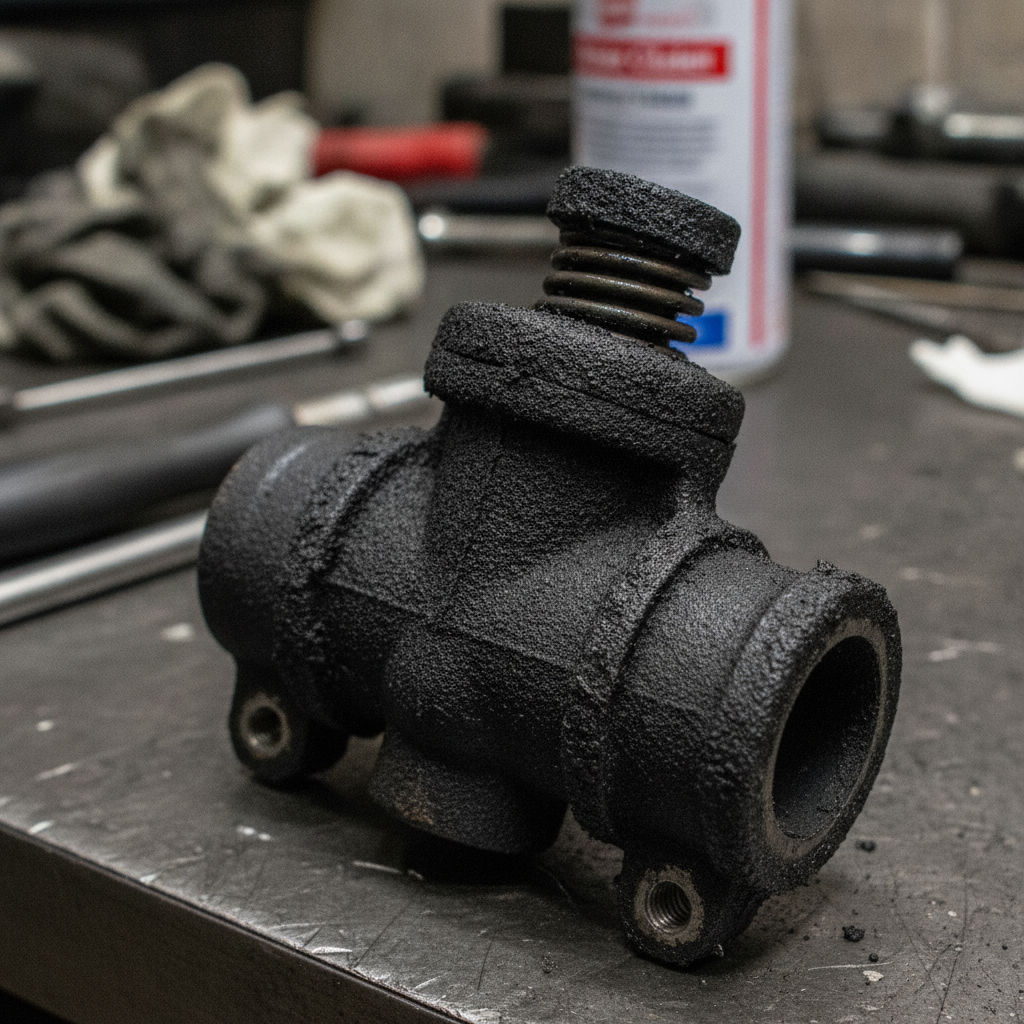
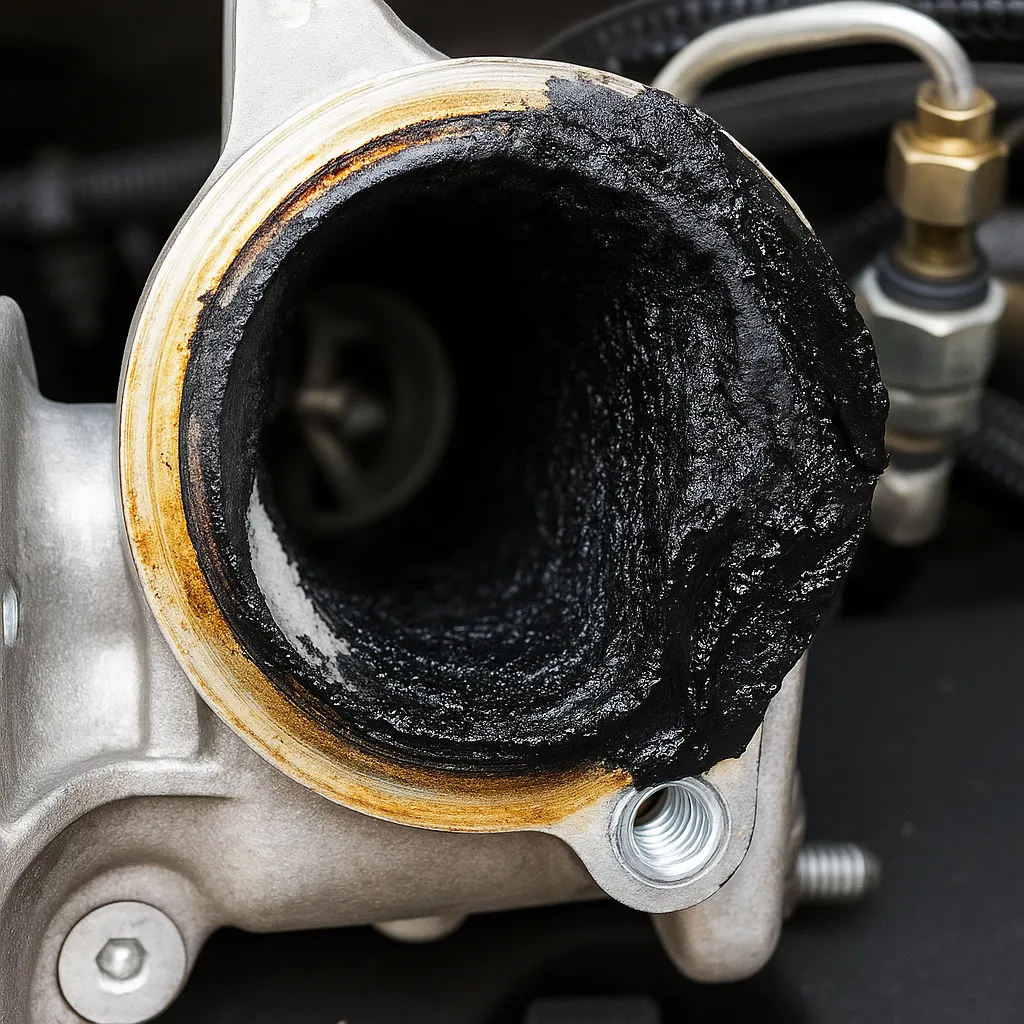
The problem is that exhaust gases carry soot, carbon and oil vapour. Over time — especially with short-journey driving — these deposits build up inside the EGR valve and on the intake manifold surfaces around it. The valve eventually sticks, operates incorrectly, or fails to seal properly.
EGR Valve Fault Symptoms
EGR fault symptoms tend to develop gradually. What starts as a barely noticeable change in how the engine feels can worsen over weeks until it becomes unmistakeable. Here are the most common symptoms and what they indicate.
Rough Idling and Hesitation
A stuck-open EGR valve allows exhaust gas into the intake even when the engine is at idle, where it doesn’t belong. This disrupts the air-fuel mixture and causes the engine to idle roughly — it may surge, hunt or feel like it’s about to cut out. Hesitation on pulling away from standstill is a closely related symptom: the engine stumbles before picking up cleanly.
Loss of Power and Sluggish Acceleration
A stuck-open EGR valve reduces the amount of fresh oxygen available for combustion at higher load. The result is a noticeable reduction in pulling power — particularly when loaded, on hills, or when overtaking. The engine feels flat and unresponsive. This symptom is easy to confuse with a DPF problem, a turbo issue or a fuel delivery fault, which is why a proper diagnostic scan matters before replacing anything.
Poor Fuel Economy
Disrupted combustion means the engine is working less efficiently. A diesel that’s running on a sub-optimal air-fuel mixture burns more fuel to achieve the same result. If your fuel consumption has crept up without a clear reason, an EGR fault is one of the first things worth checking.
Black Smoke from the Exhaust
An EGR valve stuck open at higher load creates an over-rich exhaust gas mixture — more unburnt carbon is produced than normal. This shows up as black or grey smoke from the exhaust, particularly on acceleration. If the smoke is white or blue rather than black, the cause is more likely to be coolant or oil burn rather than an EGR issue.
Engine Management Light On
An EGR fault will trigger the engine management light (EML) and store a fault code in the ECU. Common EGR fault codes include P0400 (EGR flow malfunction), P0401 (EGR insufficient flow detected), P0402 (EGR excessive flow), P0403 (EGR circuit malfunction) and P0404 (EGR circuit range/performance). The specific code helps identify whether the valve is stuck open, stuck closed, or experiencing an electrical fault in the solenoid circuit.
Failed Emissions Test
An EGR valve that’s stuck open artificially dilutes the intake mixture, which can affect combustion completeness and push NOx or particulate readings outside test limits. If your vehicle fails an MOT emissions test and there’s no obvious sign of a major mechanical issue, the EGR valve is a sensible starting point for diagnosis.
What Causes EGR Valve Faults?
Understanding the cause helps prevent the fault from returning after cleaning. Most EGR problems fall into one of three categories.
Carbon Buildup (Most Common)
This is the most frequent cause of EGR problems in diesel engines. Exhaust gases contain soot, unburnt fuel residue and oil vapour. As these pass through the EGR circuit repeatedly, they coat the valve body, the pintle and the intake port around the valve. Eventually the valve can’t move freely and sticks partially open or closed.
Carbon buildup is accelerated by short-journey driving, which prevents the engine from reaching full operating temperature. The combustion process is less complete at lower temperatures, producing more soot per cycle. Urban delivery vans are particularly vulnerable — and it’s no coincidence that EGR and DPF problems often appear together in the same vehicle.
Seized Valve (Stuck Open or Stuck Closed)
When carbon buildup progresses far enough, the valve seizes in one position. Stuck-open causes the rough idle and power loss symptoms described above. Stuck-closed prevents EGR recirculation entirely, which actually improves engine performance in the short term — but increases NOx emissions and will cause an EGR fault code. Stuck-closed faults are sometimes not noticed immediately because the engine can feel slightly more responsive without recirculation.
Electrical or Solenoid Faults
The EGR valve is controlled by an electric solenoid or a stepper motor. Wiring faults, connector corrosion or a failed solenoid can prevent the valve from responding to ECU commands even if the valve body itself is clean. An electrical fault will usually store a specific circuit code (P0403, P0404 or P0408 depending on the type of fault) and is distinguished from a mechanical fault by the diagnostic scan results.
Is It Always the EGR Valve?
EGR fault symptoms overlap with several other common diesel problems, so a diagnostic scan should always come before any parts replacement or cleaning decision. Power loss and rough running can be caused by turbo faults, injector wear, fuel pressure issues or DPF backpressure. Black smoke can point to a fuel delivery problem as much as an EGR issue. An engine management light with EGR codes confirms the circuit is flagging a problem, but the specific code and live data readings tell you whether it’s mechanical, electrical or carbon-related.
If the scan returns both EGR and DPF codes at the same time, this is a strong indicator that a dirty EGR valve has been accelerating DPF soot loading. Both issues need addressing — cleaning only one often results in the other returning quickly. See our article on engine faults that cause DPF blocking for more on this relationship.
A note on the pressure sensor: The EGR system on some engines includes a differential pressure sensor that monitors flow through the valve. A faulty sensor can generate EGR fault codes even when the valve itself is fine. Flow sensor replacement is straightforward and much cheaper than replacing the valve — worth ruling out through diagnostics before committing to anything else.
Can EGR Cleaning Fix the Problem?
For carbon-related EGR faults — which is the majority of cases — professional cleaning is the correct first step. Replacement is appropriate for electrically failed valves or physically damaged valve bodies, but carbon-seized valves are restorable through cleaning in most cases.
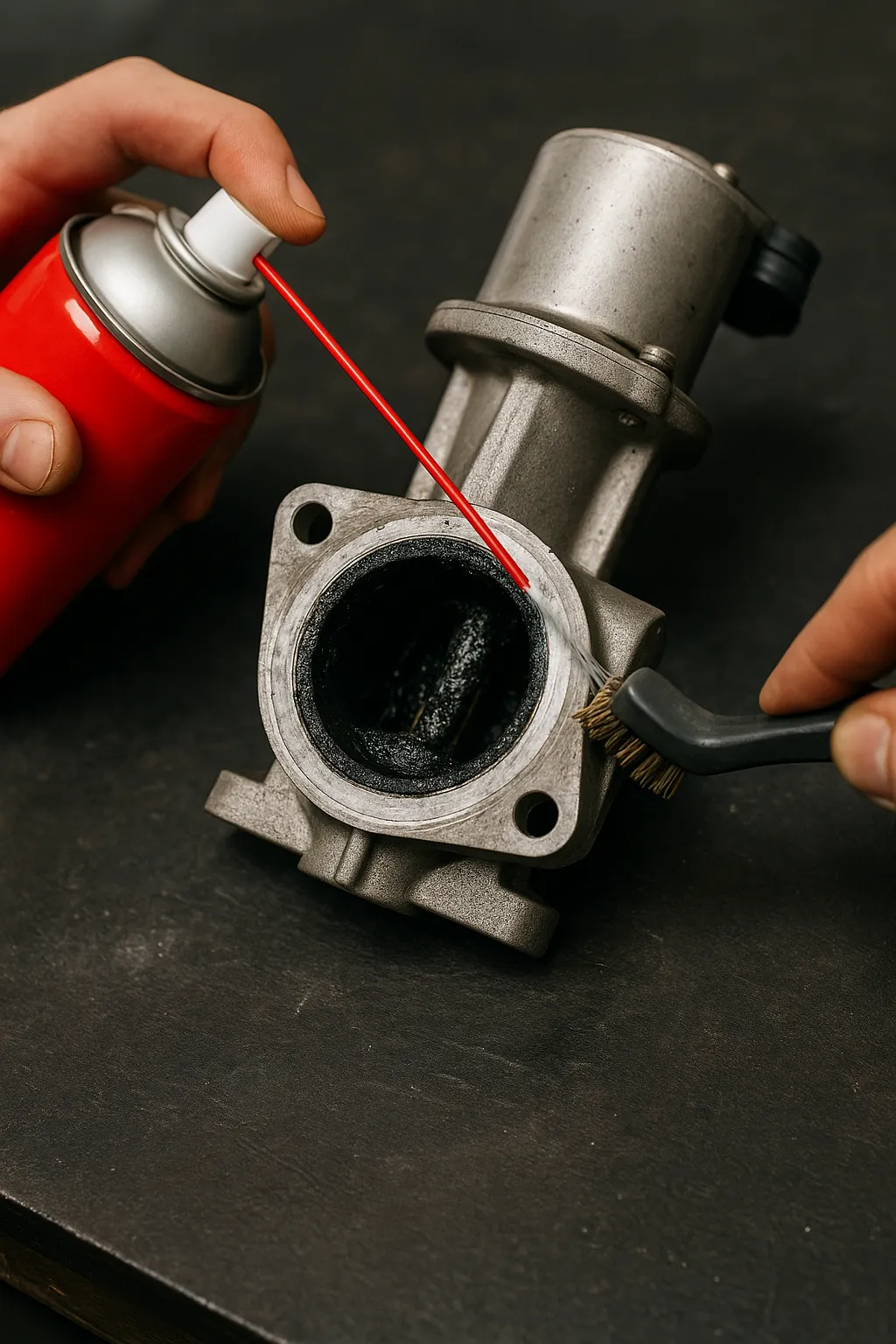
Our EGR valve cleaning service uses specialist chemical cleaning to dissolve carbon deposits from the valve body, the pintle and the surrounding intake passage. After cleaning, the valve’s movement range and response are checked before the vehicle is signed off. If the valve has any mechanical damage beyond carbon buildup, we’ll let you know rather than cleaning and returning it.
What cleaning achieves:
- Restores full valve movement range
- Clears blocked intake ports feeding the EGR circuit
- Allows the ECU to achieve accurate EGR flow readings
- Typically clears the fault code and EML without further parts replacement
Where cleaning alone isn’t enough — for example where the solenoid has failed or the valve body is cracked — a direct replacement may be necessary. We’ll diagnose this before the clean if the diagnostic data suggests it.
The EGR and DPF Connection
The relationship between EGR valve faults and DPF problems is important and often underappreciated. When the EGR valve is dirty or stuck open, combustion is disrupted and soot production increases. This soot loads the DPF faster than normal, causing premature filter blockage even on vehicles that are used on reasonable routes.
The reverse is also true: when a DPF is heavily blocked, backpressure affects the combustion cycle and can accelerate EGR carbon buildup. The two components create a feedback loop when both are in poor condition.
This is why we often recommend cleaning both the EGR valve and the DPF when a vehicle presents with both fault codes. Addressing one without the other frequently results in a faster return of symptoms. Our DPF cleaning service can be combined with EGR cleaning for a thorough result.
For vehicles with heavy intake manifold carbon deposits in addition to EGR faults, engine carbon cleaning removes buildup from the intake manifold runners, improving airflow and combustion quality at the same time.
EGR Valve Cleaning at Our Hanley Workshop
If your diesel is showing EGR fault symptoms, get it diagnosed before committing to a replacement. In most cases, professional cleaning restores full function — at a fraction of the cost of a new valve.
Frequently Asked Questions
How do I know if my EGR valve is stuck open or stuck closed?
Stuck open typically causes rough idle and reduced performance at light loads. Stuck closed often causes an EML without obvious performance issues, and may even feel slightly better than before. A diagnostic scan with live EGR position data is the definitive way to identify which state the valve is in.
Will cleaning fix a fault code P0401?
P0401 (EGR insufficient flow detected) is most often caused by carbon buildup restricting flow through the valve or the intake port. Professional cleaning typically clears this code and the EML. If the code returns quickly after cleaning, a flow sensor or solenoid fault is the more likely cause and a replacement part may be needed.
How long does EGR valve cleaning take?
EGR valve cleaning at our Hanley workshop is typically completed within a few hours. The valve is removed, cleaned, tested and refitted in a single visit for most vehicles. If significant intake manifold deposits are also being addressed, additional time may be needed.
Should I also clean my DPF at the same time as the EGR valve?
If your vehicle has both EGR and DPF fault codes, or if the DPF has been warning you recently, then yes — cleaning both at the same visit is the most cost-effective approach. It avoids the DPF re-blocking quickly because of a dirty EGR, and reduces the total time your vehicle is off the road.
Can I drive with an EGR fault?
In many cases yes, but it’s not advisable to leave it indefinitely. A stuck-open EGR valve accelerates DPF soot loading, worsens fuel economy and risks triggering limp mode over time. Getting the fault diagnosed and cleaned promptly prevents a straightforward EGR issue from turning into a combined EGR and DPF repair job.



0 Comments