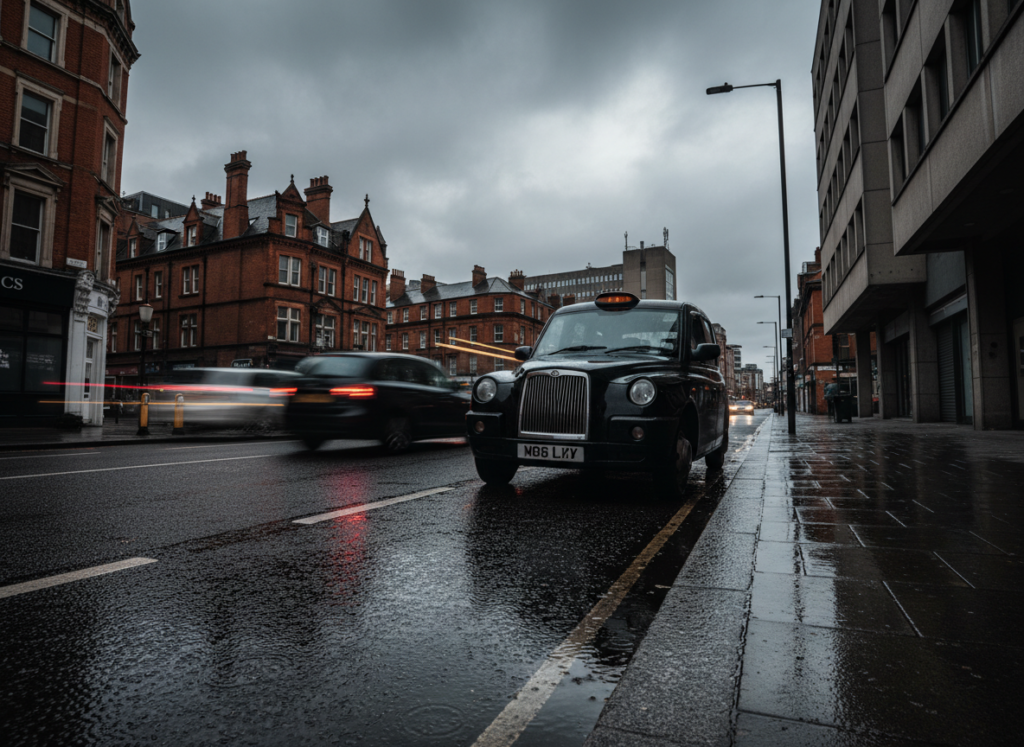
Taxi and PHV drivers are among the most common DPF problem cases we see. The combination of stop-start urban driving, long idling periods, and high annual mileage creates almost perfect conditions for DPF failure. Here’s what’s happening — and what to do about it.
A blocked DPF doesn’t just mean a warning light. For a taxi driver, it can mean limp mode in the middle of a shift, a vehicle that won’t pass a council licensing inspection, or a repair bill that wipes out a week’s income. Understanding why DPFs block faster in this line of work — and what the realistic options are — puts you in a much better position.
Taxi and private hire drivers experience DPF problems faster than most because of constant stop-start driving, frequent idling, and the high annual mileages involved. These conditions prevent passive regeneration from completing, leading to rapid soot accumulation. Professional DPF cleaning — on-car or off-car — typically needs to be factored in every year or two for this driving pattern, and acting early keeps the cost and downtime to a minimum.
Why Taxi Driving Is Hard on a DPF
A diesel engine’s DPF is designed to handle a mix of driving — some slower urban sections, but enough faster road driving to allow the filter to regularly burn off the soot it captures. That balance is what keeps the DPF self-cleaning under normal conditions.
Taxi and private hire driving breaks that balance almost completely. Most work happens in urban environments: picking up from addresses, navigating through town, dropping off, then waiting for the next booking. This pattern involves frequent short trips, slow-speed urban sections, and extended periods of idling — all of which keep exhaust temperatures too low for passive regeneration to work.
The regeneration problem
Passive regeneration — where soot burns off automatically during normal driving — requires sustained exhaust temperatures that typically only appear at faster road speeds over extended periods. A city taxi covering short urban trips rarely meets these conditions. Active regeneration (triggered by the ECU when soot load rises) needs several uninterrupted minutes to complete. Switching off the engine to wait for a passenger aborts the cycle. If this happens regularly, soot accumulates faster than the system can clear it.
Idling makes it worse
Idling is particularly harmful. At idle, a diesel engine produces minimal exhaust heat and maximum soot relative to its output. A taxi driver who idles for 30 minutes waiting for school runs or airport pickups is loading the DPF during a period when the engine can’t clear any of it. Over the course of a week of shifts, the cumulative effect is significant.
High annual mileage
Taxi and PHV drivers often cover 40,000–80,000 miles a year — or more for busy operators. At those mileages, even ash accumulation (which regeneration can’t remove) becomes a factor faster than it would for a typical private driver. A DPF that might last many years for a commuter driver may need attention within a year or two under heavy taxi use.
The numbers: At typical urban taxi speeds with stop-start and idling, a DPF can fill with soot in a fraction of the time it would for a driver doing mixed urban and motorway driving. For some taxi operators, this means DPF issues become an annual cost of business rather than an occasional event.
Signs Your DPF Is Struggling
Catching a DPF problem early is significantly cheaper and less disruptive than waiting for it to reach limp mode. Here are the signs to watch for:
- DPF warning light on the dashboard: The initial warning. If a motorway run clears it, the filter managed a regeneration. If it returns within days, the underlying blockage is too severe for self-cleaning.
- Reduced power or sluggish acceleration: A blocked DPF restricts exhaust flow, affecting engine breathing. You might notice the car feels less responsive than usual, particularly pulling away or on slight inclines.
- Limp mode during a shift: The ECU has capped power and RPM to prevent damage. The vehicle will get you to a safe stop but won’t perform normally. This needs prompt attention — it won’t clear itself.
- Increased fuel consumption: The engine is working harder to overcome the restriction. If your MPG has dropped noticeably, a blocked DPF can be a contributing factor.
- Strong exhaust smell at idle: During an active regeneration attempt, you’ll often notice a faint hot or slightly acrid smell from the exhaust. If this happens frequently, the ECU is constantly trying to clear a filter that isn’t clearing properly.
- White or blue smoke on startup: Can indicate a filter under severe stress or unburned fuel from repeated failed regeneration attempts.
Don’t finish the shift first: Tempting as it is to keep going when work is busy, driving in limp mode puts additional strain on the engine and turbo. The repair cost for associated damage is considerably higher than a DPF clean done promptly.
DPF Problems and Licensing Implications
Local authority licensing inspections typically include an emissions check as part of the vehicle fitness assessment. A DPF that’s blocked or has been tampered with can cause a vehicle to fail on emissions, leading to a failed inspection and the loss of the vehicle licence until the problem is resolved.
For obvious reasons, a DPF should never be removed or bypassed on a licensed taxi or PHV. The emissions implications aside, a vehicle with a removed DPF is not road-legal for use in a licensed role and would fail any DVSA or local authority inspection immediately. Beyond compliance, the environmental argument is also clear — DPFs exist to reduce harmful particulate matter from exhaust, and PHV fleets operating in urban areas are a significant contributor to local air quality.
The practical outcome: a blocked DPF on a licensed vehicle needs to be fixed properly, not worked around. Professional cleaning is the compliant, effective, and cost-realistic solution for most cases.
Cleaning Options for PHV Drivers
The right cleaning route depends on how blocked the DPF is and what the diagnostic data shows. A proper diagnostic first is important — it determines the soot load, the back-pressure reading, and whether there’s an underlying fault contributing to the blockage. That information shapes which option makes sense.
On-Car DPF Cleaning
Specialist cleaning agents introduced to the filter while still fitted, followed by a monitored forced regeneration. No removal required. Works well for filters with heavy soot loading that haven’t yet reached the point of physical restriction. Typically a half-day process.
Off-Car DPF Cleaning
Filter is removed, thermally cleaned, flow-tested before and after. The most thorough option — removes both soot and ash accumulation. Appropriate for heavily blocked filters or high-mileage vehicles where ash is a factor. Before-and-after flow data confirms the result.
Postal DPF Cleaning
The filter is removed, packaged, and sent to our Fenton workshop. Cleaned and returned. Useful for PHV drivers outside the immediate area who can’t afford downtime driving to a specialist but can source a temporary replacement filter while theirs is being cleaned.
For taxi operators running multiple vehicles, it can be worth discussing a fleet approach — understanding the DPF status across the fleet and scheduling cleans proactively rather than reacting to each failure in turn. Proactive cleaning is typically cheaper per incident than emergency intervention after limp mode.
Same-day availability: We understand that a taxi off the road is income lost. We offer same-day appointments where possible — contact us to discuss your situation and we’ll advise on the fastest route to getting the vehicle back to work.
How to Minimise DPF Problems in a Taxi or PHV
You can’t change the nature of urban taxi work, but there are practical steps that meaningfully reduce how quickly the DPF blocks up.
Take a motorway run between shifts
Even 20–30 minutes at motorway speed a few times a week gives the DPF a chance to passively regenerate. If your shift ends near a dual carriageway or motorway, building in a brief faster road section before parking up is worth doing.
Minimise extended idling
Idling produces heat and exhaust with very poor conditions for regeneration. Where safe and practical, switching off rather than idling for extended waits reduces unnecessary soot loading. Even engine-off waiting of 10 minutes is better than 10 minutes of idle.
Don’t switch off mid-regen
If you notice a change in idle character — slightly higher revs, a faint exhaust smell, slight temperature increase on the gauge — the car is likely in an active regen cycle. Let it complete before switching off if safe to do so. Interrupting it leaves partially burned soot that’s harder to clear next time.
Use the correct engine oil
Low SAPS (low sulphated ash, phosphorus, sulphur) engine oil is specified for modern diesel engines with DPFs precisely because standard oil additives create more ash residue in the filter. Using the wrong grade — even if it’s the right viscosity — accelerates ash accumulation over time. Check your handbook for the approved spec.
Act on the warning light promptly
Early intervention is always cheaper. A DPF showing an initial warning light can often be dealt with via on-car cleaning. The same DPF ignored for months may need off-car cleaning, or in severe cases, replacement. The warning light is there for a reason — don’t wait for limp mode to force the issue.
Common Taxi DPF Issues by Vehicle Type
Some vehicles are more commonly seen for DPF work than others in the taxi and PHV sector, primarily because of their popularity rather than any specific design flaw.
Ford Galaxy / S-Max TDCi
Popular as MPV taxis and private hire vehicles, particularly for airport work and larger groups. The 2.0 TDCi engine is a competent unit, but the DPF is susceptible to the same urban-driving accumulation issues as any diesel. EGR valves on these engines can also contribute to faster soot loading if they haven’t been serviced.
Toyota Prius Plug-In / Hybrid-diesel variants
While many Prius taxis run petrol-hybrid engines (which don’t have DPFs), some PHV operators use diesel-hybrid or straight diesel variants, particularly in fleet configurations. These tend to fare better on urban driving than conventional diesels due to the hybrid assist, but if a diesel-only vehicle is being used for heavy urban work, the DPF remains a risk.
Mercedes Vito and V-Class
Increasingly popular for executive PHV and airport transfers. The Vito with CDI diesel engines sees regular DPF problems in urban use — the combination of a larger engine producing more soot and stop-start urban driving is a common recipe. The V-Class fares similarly. Pressure sensor issues alongside blockage are common on these.
Volkswagen Caravelle / Transporter
Used by some PHV operators for larger-group transport. The TDI diesel units in these vans are robust, but the DPF on a vehicle being used for urban shuttle work needs regular attention. Injection system cleanliness is worth checking alongside any DPF work on these engines.
Not sure about your specific vehicle? Contact us with the make, model, and engine size and we can advise on what to expect and what to look out for.
The Cost Argument for Proactive DPF Cleaning
For taxi drivers, the economics of DPF cleaning are straightforward: a clean done proactively when the first warning signs appear is cheaper than a clean (or replacement) done after limp mode, and the downtime is shorter. An on-car clean typically takes a few hours. A vehicle in limp mode that needs an off-car clean takes longer to recover, and if the situation has been left long enough to require replacement, the cost increases significantly.
The more uncomfortable scenario is a DPF that’s been ignored to the point where it’s damaged rather than just blocked. Extreme soot loading that has been burned hard and incompletely can produce melted or cracked substrate — at that point, cleaning isn’t possible and replacement is the only option. A DPF replacement on a larger vehicle isn’t cheap.
The pattern we see most often with taxi operators is a warning light that was ignored for a few weeks because the vehicle was still running, followed by limp mode, followed by an emergency booking. Acting on the warning light promptly would have resulted in a shorter intervention and a lower bill. It’s a straightforward trade-off once you’ve been through it once.
DPF Warning Light On? Let’s Get You Back on the Road
We understand taxi downtime costs money. We run a proper diagnostic first — back-pressure, soot load, live data — and tell you honestly what the filter needs. Same-day availability where possible.
Helpful Next Reads
FAQs
How often should a taxi DPF be cleaned professionally?
For typical urban taxi and PHV use, every 1–2 years is a realistic expectation, though this varies significantly by vehicle type, annual mileage, and how much urban vs faster road driving is involved. Some high-mileage operators find annual cleaning becomes part of the normal maintenance schedule.
Will my vehicle fail a licensing inspection with a blocked DPF?
An emissions failure caused by a blocked DPF can lead to a failed vehicle fitness inspection. Local authority requirements vary, but emissions testing is a standard part of licensed vehicle checks. A blocked DPF should be treated promptly rather than left until inspection time.
Is it worth fitting a DPF delete on a taxi to avoid the problems?
No. DPF removal or bypass makes the vehicle non-compliant with emissions legislation, will cause it to fail any inspection, and is illegal for road use. Beyond the legal issue, any licensing body would take a very serious view of an operator running a vehicle with a removed DPF. Professional cleaning is the only compliant solution.
Can I book same-day DPF cleaning for my taxi?
We accommodate urgent bookings where our schedule allows. Contact us to explain the situation and we’ll advise on the earliest available slot. If you’re in limp mode, let us know — we’ll do our best to prioritise getting you back on the road.
Do you work on all taxi and PHV vehicle types?
We work on diesel vehicles up to 3.5 tonnes. Most common taxi and PHV vehicles fall within this — saloons, MPVs, larger SUVs, and light commercial vehicles. If you’re unsure whether your specific vehicle is covered, contact us with the details and we can confirm.