
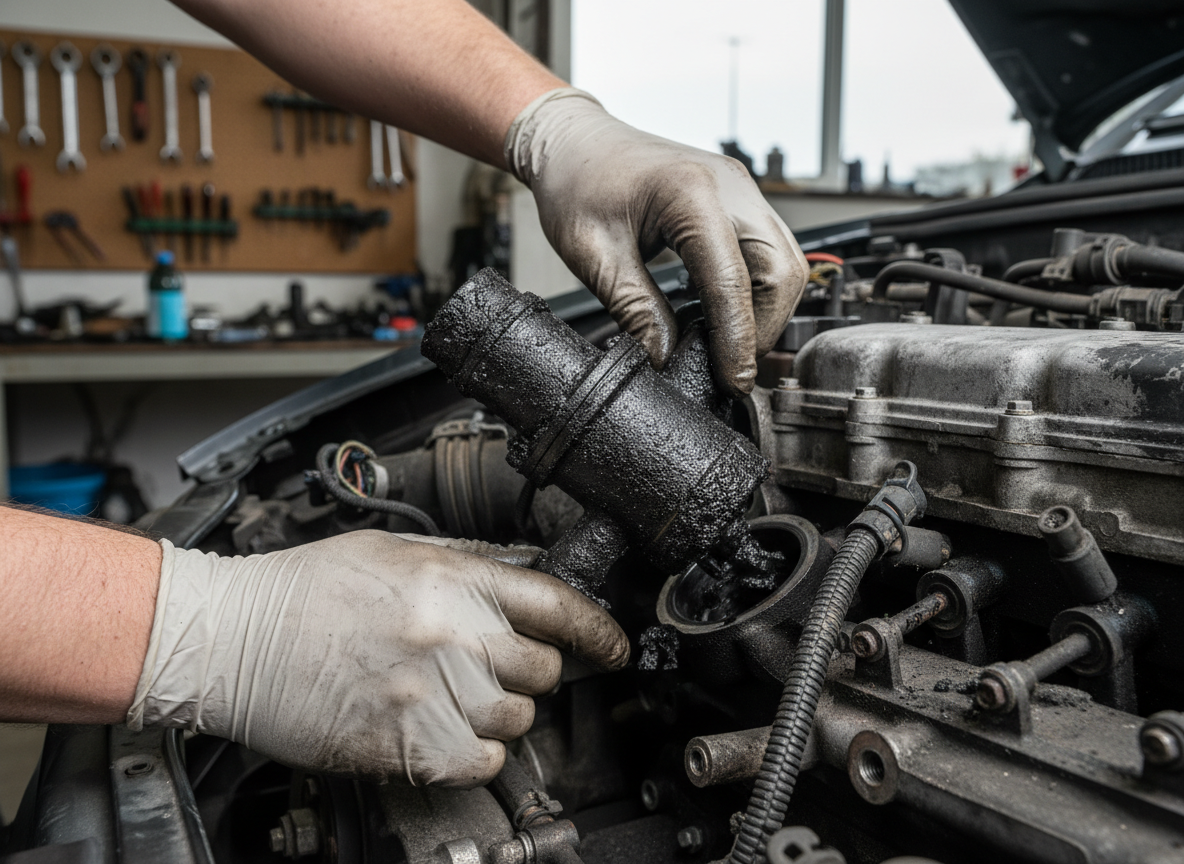

DPF Removal: Legal Risks, MOT Failure and the Real Cost of “Just Deleting It”
Cleaning quotes feel steep, so plenty of drivers ask whether the filter can simply be taken out. The short answer is no — not if the car still uses public roads. Here is what actually happens when a DPF is deleted, and why proper cleaning is almost always the better answer.
Quick answer
Removing a DPF from a road-going UK diesel is illegal under the Road Vehicles (Construction and Use) Regulations, fails the post-2018 MOT visual and smoke test, and voids most motor insurance policies. A specialist clean — on-car, off-car, or by post — restores filter flow at a fraction of the cost of replacement and keeps the car compliant.
In this guide
Why drivers consider DPF removal
The conversation usually starts the same way. The car is in limp mode, a warning light is showing, and a main-dealer quote for a new filter has come in at four figures. At that point a back-street offer of “we can take the guts out for a couple of hundred quid” sounds attractive.
The pitch normally claims three things: that the car will run better without the DPF, that the ECU can be remapped so no warning lights come back, and that nobody will ever know. None of those promises survive a modern emissions test, an insurance assessor, or a careful buyer. They also ignore the fact that on most modern diesels the DPF works alongside the EGR and SCR systems, so removing it usually triggers a chain of new faults rather than fixing the existing one.
It is worth understanding what is actually wrong before agreeing to anything. A clogged DPF is almost always a symptom of something else — short journeys, a failing pressure sensor, an injector issue, or a filter that is full of ash and needs a deep clean. Removing the part hides the symptom but leaves the cause untouched.
The legal position in the UK
This is the part DPF delete sellers tend to skip over. Since February 2014 the Department for Transport has been clear that removing a DPF from a vehicle originally fitted with one is an offence. It breaches the Road Vehicles (Construction and Use) Regulations 1986, and the vehicle stops meeting the type approval it was sold under.
The penalty is up to £1,000 for a car and £2,500 for a light goods vehicle. More importantly, the vehicle is no longer road legal. That status does not depend on whether the warning light has been mapped out, whether the car looks externally normal, or whether the owner knew about the change.
Important: “Type approval” is what makes a road vehicle legal in the first place. Removing the DPF revokes that approval, regardless of how convincing any remap or hollowed replica looks from underneath the car.
It is also worth noting that the original DfT statement explicitly covers fitting a “hollowed-out” replacement that looks like a DPF but does nothing — a common workaround offered by less reputable garages. The legal position treats that as removal.
How an MOT picks up a removed DPF
Since the 2018 MOT changes, testers are required to do two things on diesels with a DPF. First, a visual inspection underneath the car to confirm the filter is physically present. Second, a smoke test designed to catch tampered exhaust systems. Both checks were tightened specifically because DPF removal had become widespread.
The visual check is straightforward. A trained tester knows what a factory DPF looks like for the make and model in front of them, and a hollow can or a missing filter is usually obvious within seconds. Welds, mismatched pipe diameters, and the absence of the usual differential pressure sensor pipework all stand out.
The emissions test is the second hurdle. Even if a hollowed shell passes the visual, the smoke output of a deleted diesel under load is far higher than the new MOT limit allows. Cars that pass earlier MOTs after removal often start failing once the tester does a proper run-up.
What happens when a removed DPF is spotted
The MOT result is an automatic fail under “Exhaust System – Major Defect”. The car cannot be driven on the road until it is rectified. In practice that means refitting a working DPF, which is now far more expensive than cleaning the original would have been — because the original is usually long gone.
If the tester suspects deliberate tampering, the failure can also be flagged to DVSA, who can pursue the £1,000 fine. The driver who paid for the delete is the one left dealing with the consequences, not the garage that sold the work.
Insurance and DPF deletes
Every UK motor insurance policy includes a clause requiring the vehicle to be road legal at the time of any claim. A removed DPF makes the car not road legal. Insurers know this, and assessors are trained to look for the signs after a claim — particularly on diesels involved in serious incidents.
The risk is twofold. A claim can be reduced or refused outright, leaving the driver to cover repair costs. And in the worst case — for example a third-party injury claim — the insurer pays out under their statutory obligation but then pursues the policyholder for the full amount. Drivers have been left with six-figure repayments triggered by undeclared modifications.
Even where a claim is paid, the policy is usually voided going forward. The driver then has to declare a cancelled-for-fraud policy on every future quote, which pushes premiums into a different bracket entirely.
Worth knowing: A DPF delete counts as a modification under almost every UK policy. Even disclosing it does not usually solve the problem, because the modification itself is illegal — most insurers cannot legally insure a non-road-legal vehicle.
Resale value, finance and part-exchange
The other cost most owners overlook is what happens when it is time to sell or part-exchange the car. Any reputable dealer puts a diesel through an inspection that includes a DPF check. A removed filter is almost always picked up, and the trade-in offer either collapses or the car is refused outright.
Selling privately is no easier. Buyers using pre-purchase inspections will spot the change, and an honest seller has to disclose it — at which point the asking price drops sharply. Buyers who do not check tend to find out at the first MOT after purchase.
For cars on PCP or HP finance there is an additional issue. The finance agreement requires the car to be returned in road-legal condition. A removed DPF can trigger a recharge that runs into thousands at the end of the term, on top of any voluntary termination fee.
The cleaning alternative — what it costs and what it fixes
Most of the time, the dealer quote that triggered the DPF removal idea was for a brand-new filter — and that is genuinely expensive on prestige diesels. But a brand-new filter is almost never necessary. A specialist clean removes accumulated soot and ash from the original filter, restores flow and back pressure, and gets the car back into normal regeneration. It costs a fraction of replacement and keeps everything legal.
| Option | Indicative cost | Legal | What it actually fixes |
|---|---|---|---|
| Specialist off-car DPF clean | £300 – £500 | Yes | Soot and ash blockage; restores flow rate |
| On-car forced regeneration | £100 – £200 | Yes | Lighter soot loading — does not remove ash |
| Postal DPF clean (UK-wide) | £250 – £450 | Yes | Same as off-car clean, posted in and back to you |
| New genuine DPF | £1,500 – £3,500 | Yes | Severe damage where the substrate is broken |
| DPF removal / delete | £300 – £600 | No | Hides the warning light only |
For nine drivers out of ten the right answer is a proper off-car clean, often combined with a check of the differential pressure sensor and a quick look at driving habits. That combination usually returns the car to full health for years, without any of the legal exposure a delete creates. If you are too far from Hanley to drop the car in, our postal DPF cleaning service handles UK-wide jobs the same way.
How a proper diagnostic differs from a “quote on sight”
A good DPF specialist runs a live data check before recommending any work. Soot loading, ash mass, differential pressure across the filter, EGR position, and any related fault codes are all read. Only then is a decision made on whether the filter genuinely needs replacing, cleaning, or simply a forced regen. A garage that quotes for a new DPF without doing this is guessing — and it is usually guessing in an expensive direction.
Get a real answer before you spend on replacement
Workshop-based DPF diagnostics in Hanley, Stoke-on-Trent — plus UK-wide postal cleaning. Proof-led work, no guesswork.
Frequently asked questions
Is DPF removal ever legal in the UK?
Only on vehicles used purely off-road or for motorsport that never touch a public road. Any car, van, or HGV used on UK roads must keep its DPF in working order. There is no exemption for older diesels or for cars that have been remapped.
Can the DVLA tell from the V5 that a DPF has been removed?
The V5 itself does not record DPF status. The check happens at MOT time, during an insurance claim assessment, or during a pre-purchase inspection. There is no central register, but the issue surfaces quickly the moment the car is properly inspected.
What if a previous owner removed the DPF without telling me?
Bring the car in for a proper inspection. We can confirm whether the filter is original, hollowed out, or replaced, and quote for a legal restoration. Acting promptly puts you in a stronger position with both insurer and seller if there are grounds for redress.
Is a “stage one” remap with DPF delete different from a basic delete?
Legally, no. The remap hides the warning lights but does not put the filter back. From an MOT, insurance, and type-approval perspective the car is still non-compliant. The remap simply makes the problem harder to spot from the driver’s seat.
How long does a proper DPF clean take?
An off-car clean is normally same-day or next-day depending on workload. We remove the filter, run a multi-stage cleaning cycle, flow-test it, and refit it with a fresh gasket. Most cars are back on the road within 24 hours. Postal turnaround is usually 2–3 working days from receipt.
DPF Cleaner — workshop-based DPF cleaning in Hanley, Stoke-on-Trent, with UK-wide postal cleaning for customers outside Staffordshire.

0 Comments