
MOT advice for diesel drivers
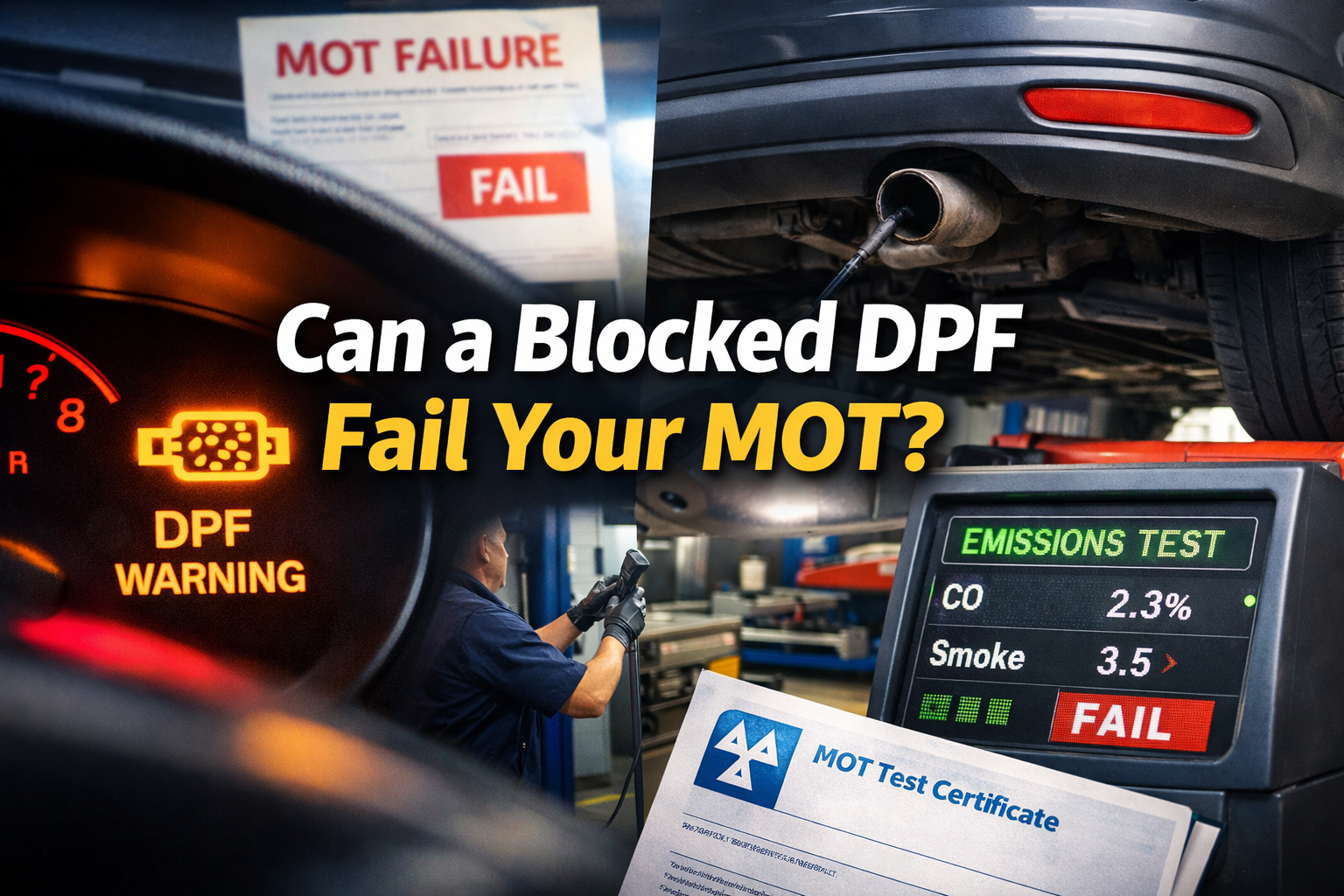
Can a Blocked DPF Fail Your MOT?
Yes — in two different ways. Here is what MOT testers actually check, what the DPF warning light means before a test, and what to do about it.
If your DPF warning light is on and your MOT is coming up, you are right to be concerned. A blocked or faulty diesel particulate filter can cause an MOT failure — and it can do so in more than one way. This guide explains exactly what testers look for, how the DPF warning light factors in, and whether a professional clean before the test is enough to protect your pass.
Yes, a blocked DPF can fail your MOT. Testers carry out a visual check to confirm the filter is present and has not been tampered with, and they also test exhaust emissions. A heavily blocked filter can push particulate output above legal limits, causing an emissions failure. If your DPF warning light is on before an MOT, it should be investigated and resolved beforehand.
How the MOT Tests Your DPF
Since February 2014, diesel particulate filters have been included in the MOT test as a required check. Before that date, testers only looked at visible smoke from the exhaust. The rules have since been tightened, and there are now two distinct ways a DPF issue can cause a failure.
The Visual Check
The first check is straightforward: the tester confirms that a DPF is present in the exhaust system. If a vehicle was originally fitted with one and it has been removed, the vehicle fails automatically. This is also true if the filter has been obviously cut open and rewelded — a common sign of unauthorised gutting — unless documentary evidence of a legitimate repair reason is provided.
The visual check does not require the tester to remove anything or access the filter directly. They inspect what is visible and identifiable in the exhaust system. For the vast majority of diesel vehicles presented for an MOT, the filter will be in place, and this check will not be the problem. The issue is more likely to arise from the second check.
The Emissions Check
The emissions check is where a blocked DPF is most likely to cause a failure. The MOT test measures exhaust smoke opacity — the density of particulate matter coming out of the exhaust. If soot levels are high enough to push opacity above the legal limit, the vehicle fails on emissions regardless of whether the filter is physically present.
A DPF that is heavily blocked restricts exhaust flow. That causes back-pressure to build, forces the engine to work harder, and can result in higher levels of unburned soot escaping into the exhaust. Combined with the fact that a blocked filter is no longer filtering efficiently, the result is exhaust output that exceeds what the test allows.
It is also worth noting that an active DPF warning light on the dashboard is, in itself, a fail under the MOT rules. Any dashboard warning lamp that the vehicle's own systems have illuminated to indicate a malfunction is a mandatory failure point. If that light is the DPF warning light, it counts against you before the smoke test even begins.
Important: Removing or disabling a DPF on a vehicle used on public roads is illegal under the Road Vehicles (Construction and Use) Regulations. Penalties include fines of up to £1,000 for private vehicles. This is separate from the MOT failure — the legal exposure remains even if the vehicle passes elsewhere.
What the DPF Warning Light Means for Your MOT
The DPF warning light is your vehicle's way of telling you the filter is approaching or has reached a point where normal passive regeneration is not keeping up. It does not always mean the filter is severely blocked — in some cases it means soot load has reached a threshold where the car needs a longer run at higher speeds to trigger a regeneration cycle.
However, from a practical MOT perspective, any active warning lamp is a failure point. The tester is required to record it. So even if the filter itself is not yet at critical soot levels, a dashboard DPF light on the day of the test will cost you a pass.
There is also a knock-on effect. When a DPF warning light is active for an extended period, it usually means regeneration has not been completing successfully. Soot continues to accumulate during that time. By the time the MOT arrives, the filter may have been sitting at elevated soot levels for weeks, which increases the likelihood of an emissions failure too.
| DPF situation | MOT outcome risk |
|---|---|
| DPF missing or obviously tampered with | Automatic failure — visual check |
| DPF warning light active on dashboard | Failure — dashboard warning lamp rule |
| DPF heavily blocked, high soot output | Likely failure — emissions/smoke opacity test |
| DPF partially restricted, no active warning | May pass — borderline risk on emissions |
| DPF recently cleaned, light cleared | Low risk — reduced particulate output |
How Far in Advance Should You Act?
Ideally, if you know your MOT is coming up and your DPF light has been active — or has been flashing repeatedly over recent weeks — you should address it at least one to two weeks before the test date. This gives you time to have the filter properly cleaned and tested, and to confirm the warning light has cleared before presenting the vehicle.
Leaving it until the day before creates unnecessary risk. A professional DPF clean removes soot and verifies filter flow, but it takes time for the vehicle's systems to reset and for a forced regeneration to confirm the filter is operating correctly. Booking with a few days in hand means any follow-up diagnosis — if underlying faults are found during the cleaning process — can still be addressed before the test.
-
1Book a diagnostic and DPF clean
Check soot load, back-pressure, and confirm whether the blockage is soot-based or ash-based. A professional clean with before-and-after flow testing gives you real data on where the filter stands.
-
2Confirm the warning light has cleared
After cleaning and a forced regeneration, the DPF light should clear. If it returns within days, there may be an underlying fault — sensor, EGR valve, injector — that needs attention before the MOT.
-
3Take the vehicle for a motorway run
After a professional clean, a 20 to 30 minute motorway run at steady speed helps confirm the regeneration system is working normally and the filter is sustaining good flow.
-
4Attend the MOT with the light off and the filter confirmed clean
Present the vehicle with no active DPF warning and a recently serviced filter. This is the lowest-risk position for passing the emissions and visual checks.
Will a Professional DPF Clean Help You Pass?
In most cases, yes — provided the filter is still structurally sound and has not been damaged by sustained overheating or contamination from oil or coolant. A professional clean removes the accumulated soot that is causing restricted flow, reduces particulate output, and clears the stored fault codes that are keeping the warning light on.
At DPF Cleaner in Stoke-on-Trent, the process uses a three-stage chemical flush followed by a controlled forced regeneration. Before and after flow readings are taken using live diagnostic data, so there is no guesswork about whether the clean has worked. If the filter is too compromised to be restored by cleaning — which is relatively uncommon — that will be apparent from the data before the vehicle leaves the workshop.
What a DPF clean cannot fix is an underlying fault causing the DPF to block repeatedly. If the EGR valve is sticking, the injectors are leaking, or the turbo is pushing oil into the exhaust, cleaning the filter is a short-term measure. Those faults will cause the filter to re-block. A proper pre-MOT approach means diagnosing the full picture, not just addressing the filter in isolation.
For customers outside the Stoke-on-Trent area who cannot bring the vehicle in, the postal DPF cleaning service allows the filter to be removed locally, sent to the Fenton workshop, cleaned and flow-tested off-car, and returned. This is a practical option for fleet operators and customers further afield who still need a verified result before an MOT.
Note on additives: Fuel-based DPF cleaning additives are not a reliable solution for a DPF that is already generating a warning light or approaching an MOT. They can assist in maintaining a lightly loaded filter on regular motorway journeys, but they do not remove compacted soot and they cannot clear a fault code or reset the vehicle's adaptation values. For more on this, see do DPF cleaning additives work.
What Happens If You Fail on DPF Emissions?
An MOT failure on emissions does not mean the vehicle is written off. It means the tester has issued a fail certificate and the vehicle cannot legally be driven on public roads in its current condition, unless driven directly to a garage for repair or to a pre-arranged retest.
Following a DPF-related failure, the most common route is to have the filter professionally cleaned, faults cleared, and the vehicle retested. The retest is typically charged at a reduced rate compared to a full MOT, provided it is carried out within a specified period at the same testing station.
If the failure reveals that the DPF has been removed or gutted — even if the owner was unaware this had been done by a previous keeper — the vehicle will need a replacement filter fitted before it can be retested and used legally on the road.
The cleanest outcome is always to resolve a DPF issue before the test rather than after. A failure adds cost, creates delays, and in some cases triggers insurance questions. Addressing the filter proactively, with a proper diagnostic and clean, is the more straightforward path.
Book Your Pre-MOT DPF Clean
If your DPF warning light is on or you want to check the filter is clean before your test, our Fenton workshop carries out a full diagnostic, three-stage chemical flush, and before-and-after flow testing. Postal DPF cleaning is also available for customers outside the local area.
Helpful Next Reads
Frequently Asked Questions
Will a DPF warning light automatically fail an MOT?
Yes. Any dashboard warning lamp that is illuminated to indicate a malfunction is a mandatory failure point on the MOT test. A DPF warning light falls into this category. Even if the filter is not severely blocked, the active light on the dashboard will cause a failure on its own.
Can I drive to the MOT with the DPF light on?
You can drive to the test station, but the vehicle is very likely to fail. Driving with an active DPF warning is also not advised for extended periods, as continued blockage increases pressure on the turbo, sensors, and injectors. It is better to address the light before booking the test.
How long does a pre-MOT DPF clean take?
At our Fenton workshop, an on-car DPF clean including diagnostic, flush, and forced regeneration typically takes under an hour for most cars and light vans. If the filter is severely loaded or an underlying fault needs attention, additional time may be required. We recommend booking with at least a few days to spare before your MOT date.
If my DPF is cleaned, is an MOT pass guarantee (Terms & Conditions Apply)d?
No — and anyone who tells you otherwise is overclaiming. A professional clean reduces particulate output, clears the warning light, and restores filter flow. In the majority of cases where the filter is the primary issue, this is sufficient for the vehicle to meet the emissions standard. However, if there are underlying mechanical faults, or if the filter has been structurally damaged, cleaning alone may not be enough. A proper diagnostic before the clean will tell you what you are dealing with.
My previous owner may have had the DPF removed. What should I do?
If you suspect the DPF has been removed or gutted, have the vehicle inspected by a diesel specialist before presenting it for an MOT. If the filter is missing, you will need a replacement fitted before the vehicle can be retested legally. A specialist can also confirm whether the ECU has been remapped to account for the missing filter, which is relevant to understanding the full scope of work needed.