
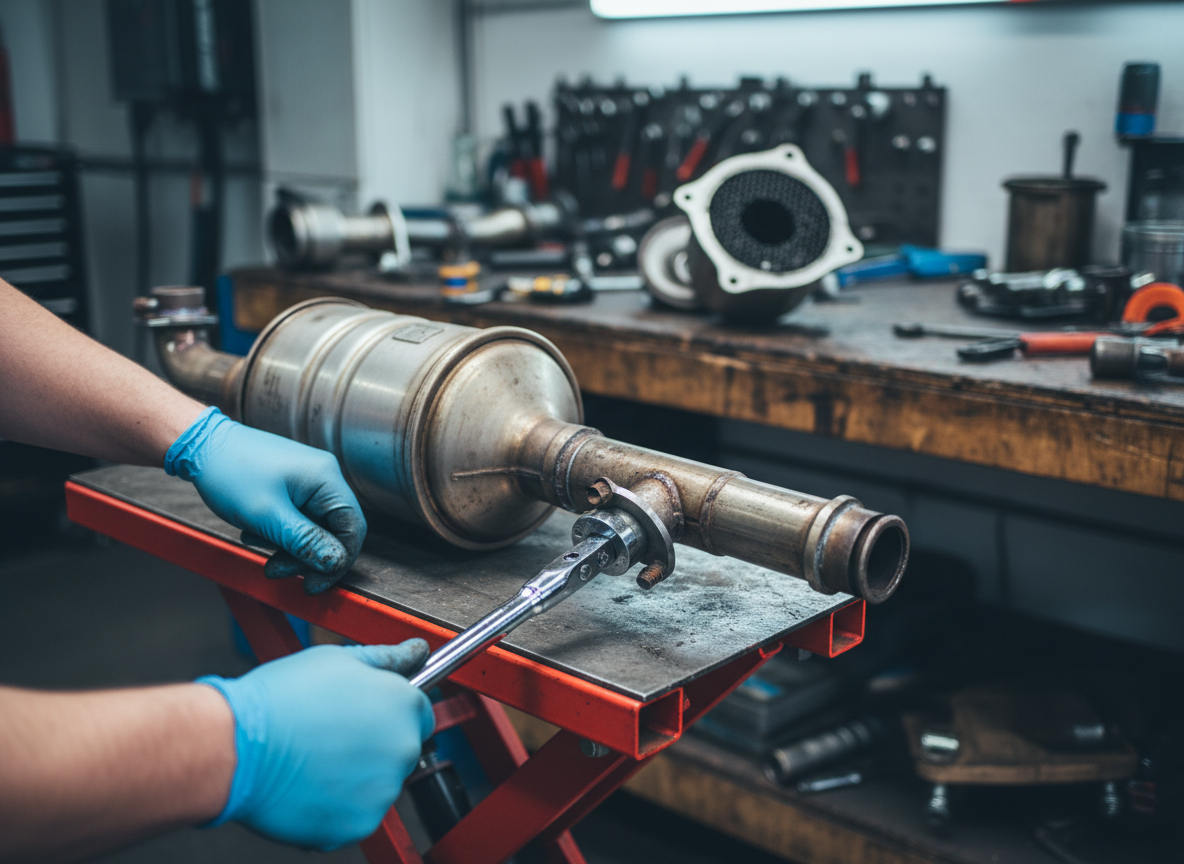

DPF Cleaner — Stoke-on-Trent
EGR Valve Cleaning and DPF Problems: Why They Often Come as a Pair
If your DPF keeps blocking and your EGR valve is clogged, the two problems are almost certainly connected. Here is how one accelerates the other — and what fixing both properly looks like.
One of the most common patterns we see is a diesel driver coming in with a blocked DPF, getting it cleaned, and returning a few months later with the same problem. When that happens, the first question is always: has anyone looked at the EGR valve?
The exhaust gas recirculation valve and the diesel particulate filter are two separate components, but they operate as part of the same emissions management system. A clogged or stuck EGR valve changes the combustion conditions inside the engine in ways that directly increase the rate at which the DPF loads with soot. Understanding that relationship is important whether you are dealing with a first-time blockage or a repeat problem.
What’s on this page
What the EGR Valve Does and Why It Gets Clogged
The EGR valve controls the flow of exhaust gas back into the engine’s intake manifold. Recirculating a portion of the exhaust gas dilutes the fresh air-fuel mixture entering the combustion chambers, which lowers the peak combustion temperature and reduces the production of nitrogen oxides — the harmful emissions that diesel engines are particularly prone to generating.
The problem is that exhaust gas is not clean. It contains soot particles, unburnt hydrocarbons, and oil vapour from the crankcase ventilation system. Over time, these deposits build up on the EGR valve itself, on the valve seat, and in the intake passages connected to it. Eventually, the valve either sticks in the open position, sticks closed, or becomes slow and sluggish in its movement.
Which driving conditions cause the fastest build-up?
Short urban journeys are the main culprit. When the engine never fully warms up, soot and hydrocarbon deposits are more likely to condense and stick rather than burn off. Diesel engines used primarily for town driving — which is common across Stoke-on-Trent and the wider Staffordshire area — see EGR valve contamination far earlier than the same engines used for regular motorway driving.
Low-quality or high-sulphur fuel also accelerates the process, as does a worn injector set producing fuel that does not atomise cleanly. Any engine fault that causes incomplete combustion will ultimately contribute to EGR fouling.
How a Faulty EGR Valve Damages Your DPF
When the EGR valve is clogged, it cannot control exhaust gas recirculation properly. Depending on whether it sticks open or closed, the effects on combustion differ — but both outcomes increase the soot load entering the DPF.
If the EGR valve sticks open
An EGR valve stuck in the open position allows too much exhaust gas back into the intake at all times. This excessively dilutes the air-fuel mixture, particularly at low engine speeds, leading to incomplete combustion and an increase in soot production. More soot reaching the DPF means the filter loads faster than it was designed to, and passive regeneration — which depends on exhaust temperatures being hot enough — becomes less effective because the diluted mixture also produces lower exhaust temperatures.
The result is a DPF that loads faster than it regenerates. Over time, the filter becomes progressively more blocked, eventually triggering a warning light even when the vehicle has had reasonably regular motorway use.
If the EGR valve sticks closed
A valve stuck in the closed position cuts off exhaust gas recirculation entirely. This raises combustion temperatures, increases NOx emissions, and tends to produce a rougher idle with more particulate emissions than normal. While this does not load the DPF as dramatically as a stuck-open valve, it still produces abnormal combustion byproducts and places additional thermal stress on the filter during attempts at regeneration.
How a Blocked DPF Makes EGR Problems Worse
The relationship works both ways. A blocked DPF does not just sit quietly downstream — it increases exhaust backpressure throughout the entire exhaust system, including in the EGR circuit.
Elevated exhaust backpressure forces more exhaust gas through the EGR path than normal, delivering a higher volume of soot-laden gas into the intake manifold. This accelerates the rate at which carbon deposits form on the EGR valve and in the intake passages. A DPF that is fifty per cent blocked will cause EGR carbon build-up to occur noticeably faster than in a vehicle with a clean filter.
This is the feedback loop that causes both components to deteriorate together. The EGR problem loads the DPF faster. The loaded DPF increases backpressure, which speeds up EGR fouling. Both get progressively worse unless both are addressed.
Symptoms That Suggest Both Are Failing
Identifying the combined EGR and DPF failure pattern is possible from the symptoms, though the picture can be confusing because several of them overlap with other diesel faults.
| Symptom | More likely EGR | More likely DPF | Could be both |
|---|---|---|---|
| Rough idle | ✓ | ||
| Black smoke on acceleration | ✓ | ✓ | |
| DPF warning light | ✓ | ||
| Loss of power / limp mode | ✓ | ✓ | |
| Increased fuel consumption | ✓ | ✓ | ✓ |
| EGR fault code alongside DPF code | ✓ | ||
| DPF blocking repeatedly after cleaning | ✓ | ✓ | |
| Engine hesitation under light throttle | ✓ |
The most telling sign is a DPF that keeps blocking after it has been cleaned. If the filter has been professionally cleaned and confirmed as flowing correctly, and it has blocked again within a relatively short period, the EGR system — or another underlying engine issue — is almost certainly the cause. See our article on what causes a DPF to block more than once for a broader look at repeat blockage causes.
What EGR Valve Cleaning Involves
EGR valve cleaning removes the accumulated carbon deposits from the valve, its seat, and the surrounding intake passages. The process varies depending on the extent of the build-up and whether the valve itself is still operational or has seized.
Mild to moderate contamination
Where the EGR valve is still moving but sluggish or partially restricted, a cleaning service removes the valve and clears the carbon deposits from the valve body, valve seat, and the coolant-side passages where applicable. The cleaned valve is then refitted and tested to confirm it is operating within the correct range across its full movement.
Heavy contamination or seized valves
If the valve has seized completely or the carbon build-up has reached a point where the internal components are damaged, replacement becomes more appropriate than cleaning. A diagnostic check before cleaning work begins confirms which situation applies, so you are not paying for a clean that cannot restore proper function.
Our EGR valve cleaning service addresses both the valve and the intake passages, with a proper assessment first to confirm what the valve actually needs rather than assuming cleaning will resolve every case.
Which to Clean First: EGR or DPF?
This is a question that comes up regularly, and the practical answer is that they should be cleaned as close together as possible — ideally in the same service visit. However, if they have to be separated, the EGR valve should be addressed first.
Here is why: cleaning the DPF first and then leaving a faulty EGR valve in place simply means the DPF will reload faster than normal from day one. You will have paid for a clean on the filter, but the underlying cause of the blockage is still active.
Cleaning the EGR valve first — or at the same time as the DPF — means the combustion conditions return to something closer to normal before the freshly cleaned DPF begins accumulating soot again. The filter then loads at the rate it was designed to, and passive regeneration has a realistic chance of keeping up.
If you are also dealing with carbon build-up in the intake manifold from the EGR deposits, an engine carbon clean can address that layer of contamination as well, restoring intake flow across the whole combustion system rather than just at the EGR valve itself.
EGR Problem? DPF Blocked? Let’s Sort Both
We carry out EGR valve cleaning and DPF cleaning as a combined service, with a proper diagnostic first to confirm exactly what each component needs. Based in Stoke-on-Trent, with UK-wide postal DPF cleaning available.
Frequently Asked Questions
Can a faulty EGR valve cause a DPF warning light?
Yes, indirectly. A faulty EGR valve increases soot production or changes combustion in ways that load the DPF faster than it can self-clean. The warning light then triggers when the DPF load reaches the threshold for a forced regeneration or a full clean. The EGR fault may also generate its own separate code alongside the DPF code.
How do I know if my EGR valve is causing my DPF to keep blocking?
The clearest indicator is a DPF that blocks repeatedly within a relatively short time after cleaning, combined with an EGR fault code showing in a diagnostic readout. Other signs include rough idle, black smoke on acceleration, and increased fuel consumption. A proper diagnostic reading live EGR data — including valve position and flow — confirms whether the EGR system is contributing to the problem.
Is it worth cleaning the EGR valve or should I just replace it?
Cleaning is appropriate where the valve is still mechanically sound and the deposits are the primary cause of reduced performance. Replacement is more appropriate where the valve has seized, the internal components are worn, or the contamination is so severe that cleaning cannot restore proper function. A diagnostic assessment before any work begins confirms which approach applies in your case.
What happens if I ignore the EGR fault and just clean the DPF?
The DPF will block again faster than it should. How quickly depends on the severity of the EGR fault and your driving pattern. In some cases the filter reloads within weeks; in others it takes a few months. But without addressing the EGR fault, each cleaning cycle becomes shorter and the problem escalates. The EGR fault also tends to worsen over time as deposits continue to build.
Can engine carbon cleaning help alongside EGR valve cleaning?
Yes. EGR deposits often extend beyond the valve itself into the intake manifold and inlet ports. An engine carbon clean addresses the broader intake contamination that the EGR valve cleaning alone may not fully resolve. For vehicles with significant mileage and long-standing EGR issues, combining both services gives the most complete result.


0 Comments